
Melanocyte-Keratinocyte Transplant Procedure (MKTP / NCES)
Autologous Non-Cultured Epidermal Cell Suspension (MKTP / NCES) transplantation or suction blister epidermal grafting (SBEG) to re-pigment stable vitiligo patches unresponsive to topical medical therapy.
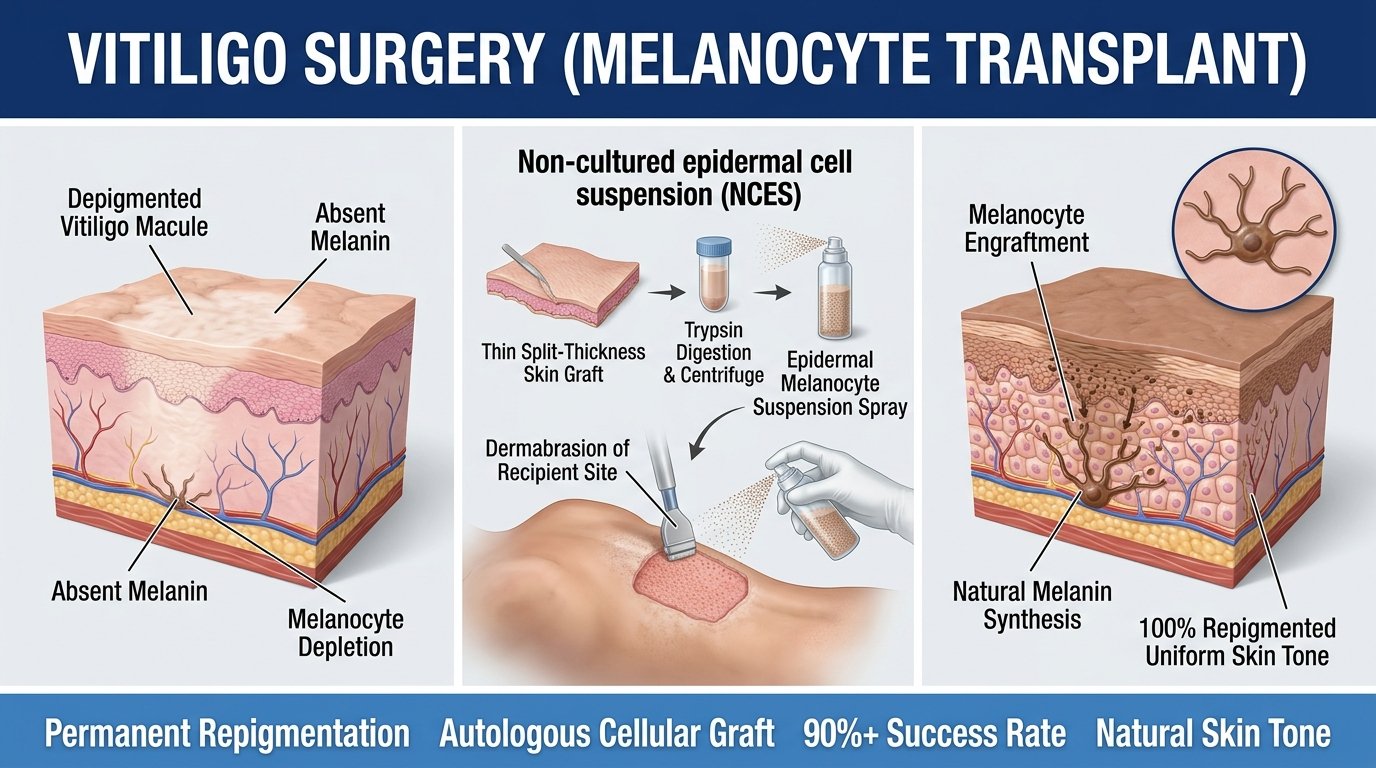 Vitiligo surgery (melanocyte transplant)
Clinical Overview & Disease Information
Autologous Non-Cultured Epidermal Cell Suspension (MKTP / NCES) transplantation or suction blister epidermal grafting (SBEG) to re-pigment stable vitiligo patches unresponsive to topical medical therapy.
Signs & Symptoms
- • Well-demarcated depigmented chalk-white macules on hands, face, or body
- • Leukotrichia (poliosis / white hair within vitiligo patch)
- • Symmetrical vitiligo macules without active enlargement for > 1 year
- • Failure of repigmentation with topical steroids and phototherapy
- • Rapid generalized Koebnerization following skin trauma
Causes & Risk Factors
Primary Causes & Etiology
- Autoimmune destruction of epidermal melanocytes (CD8+ T-cell infiltration)
- Genetic susceptibility (HLA-A2, DR4, NLRP1)
- Oxidative stress in melanocytes
Who is at Higher Risk?
- Patients with stable vitiligo (no new lesions or expansion for 12 months)
- Negative Koebner phenomenon
Diagnostic Evaluation & Testing
| Diagnostic Test | Clinical Purpose / What It Shows |
|---|---|
| Wood's Light Examination & Dermoscopy | Confirms clear ivory-white fluorescence and absence of active marginal trichrome features |
| Vitiligo Disease Activity Score (VIDA) & VASI Index | Verifies 1-year clinical stability prior to surgical transplantation |
Comprehensive Treatment Options
Autologous Non-Cultured Melanocyte-Keratinocyte Transplant (MKTP / NCES)
Harvesting ultrathin split-thickness donor graft, trypsinization to isolate cell suspension, dermabrasion of recipient vitiligo area, and cell suspension grafting under collagen dressing.
Suction Blister Epidermal Grafting (SBEG) & Mini-Punch Grafting
Harvesting intact epidermal roofs using negative pressure suction blisters for transfer onto dermabraded recipient spots.
Advanced Medical Technologies Available in Partner Hospitals
Possible Complications If Untreated
Recovery Timeline, Diet & Lifestyle Care
Recovery Timeline
| Procedure / Stage | Expected Recovery Duration |
|---|---|
| Immobilization & Dressing | 7 to 10 days |
| Initial Erythema & Pigment Buds | 3 to 6 weeks |
| Full Uniform Pigmentation (with NB-UVB) | 3 to 6 months |
Recommended Post-Treatment Diet
- Antioxidant-rich diet (Vitamin C, E, Zinc, Folic Acid)
- Hydration
Essential Lifestyle Changes
- Keep recipient surgical site strictly immobile for 7 days
- Initiate Narrowband UVB phototherapy 3 weeks post-op
- Avoid friction or scrubbing over graft area
Prevention & Long-Term Health
Frequently Asked Questions
Is vitiligo surgery permanent?
Transplanted melanocytes provide permanent repigmentation in stable vitiligo lesions.
Top Recommended Specialists Available

Global Cost Comparison Matrix
| Procedure | USA (Avg) | India (ISG) | Turkey (Avg) | Thailand (Avg) |
|---|---|---|---|---|
| Vitiligo surgery (melanocyte transplant) | $12,000 | $2,500 | $3,500 | $4,000 |
Request Free Clinical Opinion & Cost Estimate
Upload your diagnostic reports or medical summary for a free review by leading specialists within 24-48 hours.
Get Free Treatment EstimateCommonly Prescribed Medications
- Topical Tacrolimus 0.1% Ointment
- Systemic Corticosteroid Pulse Therapy
- Narrowband UVB Phototherapy
International Patient Guide
- Passport & Visa
- Vitiligo Medical History & Stability Records