
Femto-Cataract (FLACS) & 1.8mm MICS Phacoemulsification
Micro-Incision Cataract Surgery (MICS 1.8mm) and Femtosecond Laser-Assisted Cataract Surgery (FLACS) utilizing ultrasonic phacoemulsification to liquefy cloudy crystalline lenses and replace them with foldable Intraocular Lenses (IOLs).
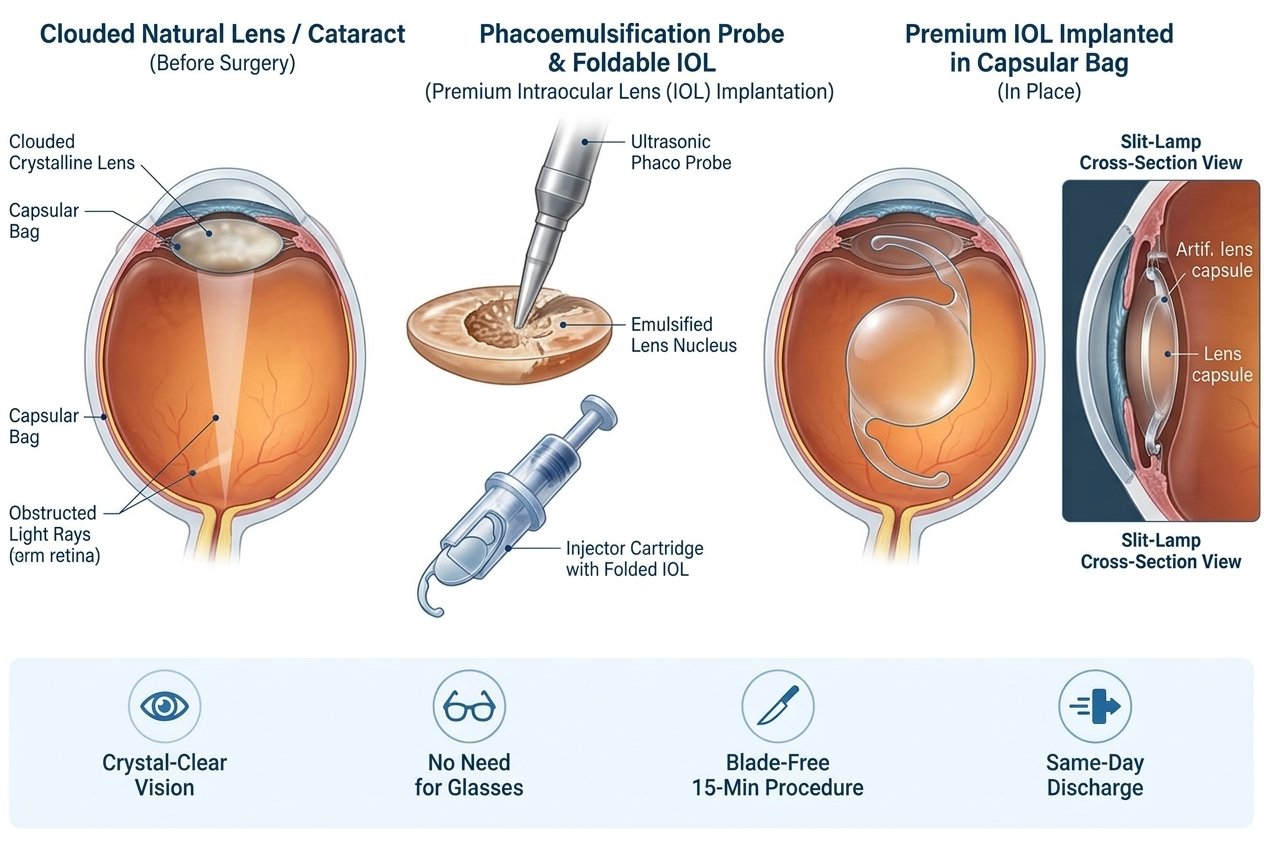 Cataract surgery — phacoemulsification, MICS
Clinical Overview & Disease Information
Micro-Incision Cataract Surgery (MICS 1.8mm) and Femtosecond Laser-Assisted Cataract Surgery (FLACS) utilizing ultrasonic phacoemulsification to liquefy cloudy crystalline lenses and replace them with foldable Intraocular Lenses (IOLs).
Signs & Symptoms
- • Gradual painless blurring of vision and fading of color vividness
- • Increased sensitivity to light and glare from oncoming headlights at night
- • Frequent changes in spectacle power
- • Monocular double vision or halos around light sources
- • Cloudy pupil reflex (advanced cataract)
- • Phacomorphic / Phacolytic glaucoma with sudden severe eye pain, red eye, and high IOP
Causes & Risk Factors
Primary Causes & Etiology
- Age-related crystalline lens protein aggregation & nuclear sclerosis
- Diabetes mellitus, long-term systemic corticosteroid therapy
- Ocular trauma or prior intraocular inflammation (Uveitis)
Who is at Higher Risk?
- Adults aged 55+, diabetic patients, individuals with prolonged sun/UV exposure
Diagnostic Evaluation & Testing
| Diagnostic Test | Clinical Purpose / What It Shows |
|---|---|
| IOLMaster 700 SWEPT-Source OCT Biometry | Measures axial length, anterior chamber depth, and calculates precise IOL power |
| Specular Microscopy Endothelial Cell Count & HD OCT Macula | Quantifies corneal endothelial cell density and excludes macular edema |
Comprehensive Treatment Options
Femtosecond Laser (FLACS) & 1.8mm Micro-Incision Phacoemulsification (MICS)
Femtosecond laser capsulotomy and lens fragmentation followed by micro-ultrasonic phacoemulsification and intraocular lens (IOL) insertion through a stitchless 1.8mm incision.
Ultrasonic Coaxial Phacoemulsification with Foldable Hydrophobic Monofocal IOL
Standard ultrasonic cataract removal and foldable IOL implantation.
Advanced Medical Technologies Available in Partner Hospitals
Possible Complications If Untreated
Recovery Timeline, Diet & Lifestyle Care
Recovery Timeline
| Procedure / Stage | Expected Recovery Duration |
|---|---|
| Eye Shield & Initial Visual Recovery | 4 to 6 hours |
| Functional Clear Vision | 24 to 48 hours |
| Complete Ocular Healing & Final Prescription | 3 to 4 weeks |
Recommended Post-Treatment Diet
- Antioxidant-rich Mediterranean diet with Lutein & Zeaxanthin
Essential Lifestyle Changes
- Wear protective eye shield during sleep for 1 week
- Do NOT rub eye or get tap water in eye for 2 weeks
- Instill eye drops as prescribed
Prevention & Long-Term Health
Frequently Asked Questions
Is cataract surgery performed under general anesthesia?
No, 98% of modern cataract surgeries are performed painlessly using topical anesthetic eye drops without needles or general anesthesia.
Top Recommended Specialists Available

Global Cost Comparison Matrix
| Procedure | USA (Avg) | India (ISG) | Turkey (Avg) | Thailand (Avg) |
|---|---|---|---|---|
| Cataract surgery — phacoemulsification, MICS | $4,500 | $1,200 | $1,800 | $2,200 |
Request Free Clinical Opinion & Cost Estimate
Upload your diagnostic reports or medical summary for a free review by leading specialists within 24-48 hours.
Get Free Treatment EstimateCommonly Prescribed Medications
- Prednisolone Acetate 1% Drops
- Nepafenac 0.1% Suspension
- Moxifloxacin 0.5% Drops
International Patient Guide
- Passport & Visa
- Biometry & Cardiac Clearance Reports