
3D-Printed Custom Joint Implants
3D-printed custom joint implants, created through additive manufacturing technologies, represent a paradigm shift in orthopedic arthroplasty from "one-size-fits-all" devices to patient-specific solutions. The technology transforms digital medical images (from CT or MRI scans) into a precise 3D model, which is then used to build an implant layer by layer using techniques like Selective Laser Melting (SLM) or Electron Beam Melting (EBM).
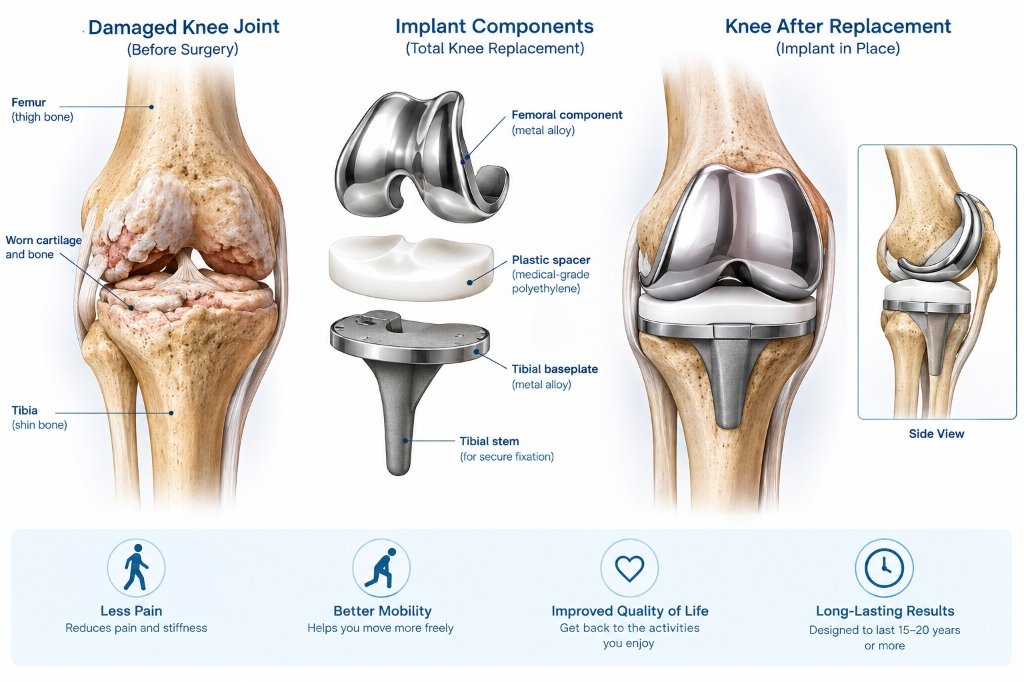 3D-printed custom joint implants
Clinical Overview & Disease Information
3D-printed custom joint implants, created through additive manufacturing technologies, represent a paradigm shift in orthopedic arthroplasty from "one-size-fits-all" devices to patient-specific solutions. The technology transforms digital medical images (from CT or MRI scans) into a precise 3D model, which is then used to build an implant layer by layer using techniques like Selective Laser Melting (SLM) or Electron Beam Melting (EBM).
Signs & Symptoms
- • Early Severe bone loss & joint instability during activity
- • Mild stiffness after rest
- • Persistent Severe bone loss & joint instability
- • Difficulty with daily mobility
- • Pain disturbing sleep
- • Severe acute pain with inability to walk
- • High fever with joint redness
Causes & Risk Factors
Primary Causes & Etiology
- Bone defect after tumor or trauma
- Post-traumatic joint injury
- Age-related cartilage degeneration
Who is at Higher Risk?
- Patients diagnosed with Bone defect after tumor or trauma
- Adults over 45 years
Diagnostic Evaluation & Testing
| Diagnostic Test | Clinical Purpose / What It Shows |
|---|---|
| 3D Imaging & X-Ray for 3D-printed custom joint implants | Precision anatomical mapping and structural evaluation |
Comprehensive Treatment Options
Minimally Invasive: Keyhole 3D-printed custom joint implants
Advanced keyhole procedure with minimal soft tissue disruption.
Surgical: Reconstruction for 3D-printed custom joint implants
Comprehensive surgical intervention for complex anatomical cases.
Advanced Medical Technologies Available in Partner Hospitals
Possible Complications If Untreated
Recovery Timeline, Diet & Lifestyle Care
Recovery Timeline
| Procedure / Stage | Expected Recovery Duration |
|---|---|
| Inpatient Recovery | 3 to 5 days |
| Physical Therapy & Walking | 3 to 4 weeks |
| Full Active Recovery | 6 to 8 weeks |
Recommended Post-Treatment Diet
- High protein healing diet
- Calcium & Vitamin D3
- 2.5L daily hydration
Essential Lifestyle Changes
- Targeted physical therapy
- Avoid heavy lifting
- Maintain healthy body weight
Prevention & Long-Term Health
Frequently Asked Questions
What is the success rate for 3D-printed custom joint implants?
Clinical success rates exceed 95% with expert surgical technique and physical therapy.
What materials are used to 3D-print joint implants?
Most load-bearing joint implants (like hips and knees) are printed using strong, biocompatible titanium alloys or cobalt-chromium. Other materials, such as PEEK (a high-performance polymer) and bio-ceramics, are used for specific applications like spinal cages or cranial reconstructions.
Are 3D-printed implants better than standard off-the-shelf implants?
For patients with severe deformities or massive bone loss, custom 3D-printed implants offer significantly better anatomical conformity, stability, and biomechanics compared to standard implants. However, for standard, straightforward joint replacements in patients with typical anatomy, there is currently insufficient evidence to prove that 3D-printed implants provide better long-term functional outcomes or longevity than traditional, established implants.
Do these implants take a long time to make?
Yes, unlike off-the-shelf implants that are ready immediately, the workflow for a custom 3D-printed implant requires several weeks. The process involves scanning, digital modeling, surgeon approval, the actual additive manufacturing process, post-processing (like polishing and heat treatment), quality control validation, and sterilization before the device reaches the hospital.
Will insurance cover a 3D-printed implant?
Coverage often depends on medical necessity. Standard-sized 3D-printed implants or custom implants for patients with typical anatomy may be considered investigational and might not be covered. However, custom 3D-printed implants for patients with severe bone or joint deformities who meet specific medical criteria (and FDA custom device exemptions in the US) are often deemed medically necessary and covered.
Top Recommended Specialists Available

Dr. I P S Oberoi
Chairperson - Orthopaedics Program & Chief – Robotic Joint Replacement & Arthroscopy Surgery
View Doctor Profile →
Dr. (Col) Suvasish Chakraberty
Sr. Consultant - Orthopaedics & Joint Replacement
View Doctor Profile →
Dr. (Prof.) Ravi Sauhta
Chief and HOD - Orthopaedics & Joint Replacement (Unit VI)
View Doctor Profile →
Dr. Sanjay Sarup
Head – Orthopaedics (Unit-II) & Chief – Paediatric Orthopaedics & Spine Surgery
View Doctor Profile →
Global Cost Comparison Matrix
| Procedure | USA (Avg) | India (ISG) | Turkey (Avg) | Thailand (Avg) |
|---|---|---|---|---|
| 3D-printed custom joint implants | $70,000-1,00,000 | $10,500-12,500 | $12,000-14,000 | $15,000-18,000 |
Request Free Clinical Opinion & Cost Estimate
Upload your diagnostic reports or medical summary for a free review by leading specialists within 24-48 hours.
Get Free Treatment EstimateCommonly Prescribed Medications
- Etoricoxib 90mg daily
- Paracetamol 1g as needed
- Calcium Carbonate + D3
International Patient Guide
- Valid Passport & Visa
- Medical Records & X-Ray CDs