
Arthroscopic Joint Surgery
Arthroscopy is a minimally invasive surgical procedure used to diagnose and treat problems inside a joint. Instead of making a large incision to open the joint completely, the surgeon uses an arthroscope—a thin, pencil-sized tube equipped with a high-definition camera and a light source. This transmits a magnified image of the inside of the joint onto a video monitor, allowing the surgeon to see and work with extreme precision.
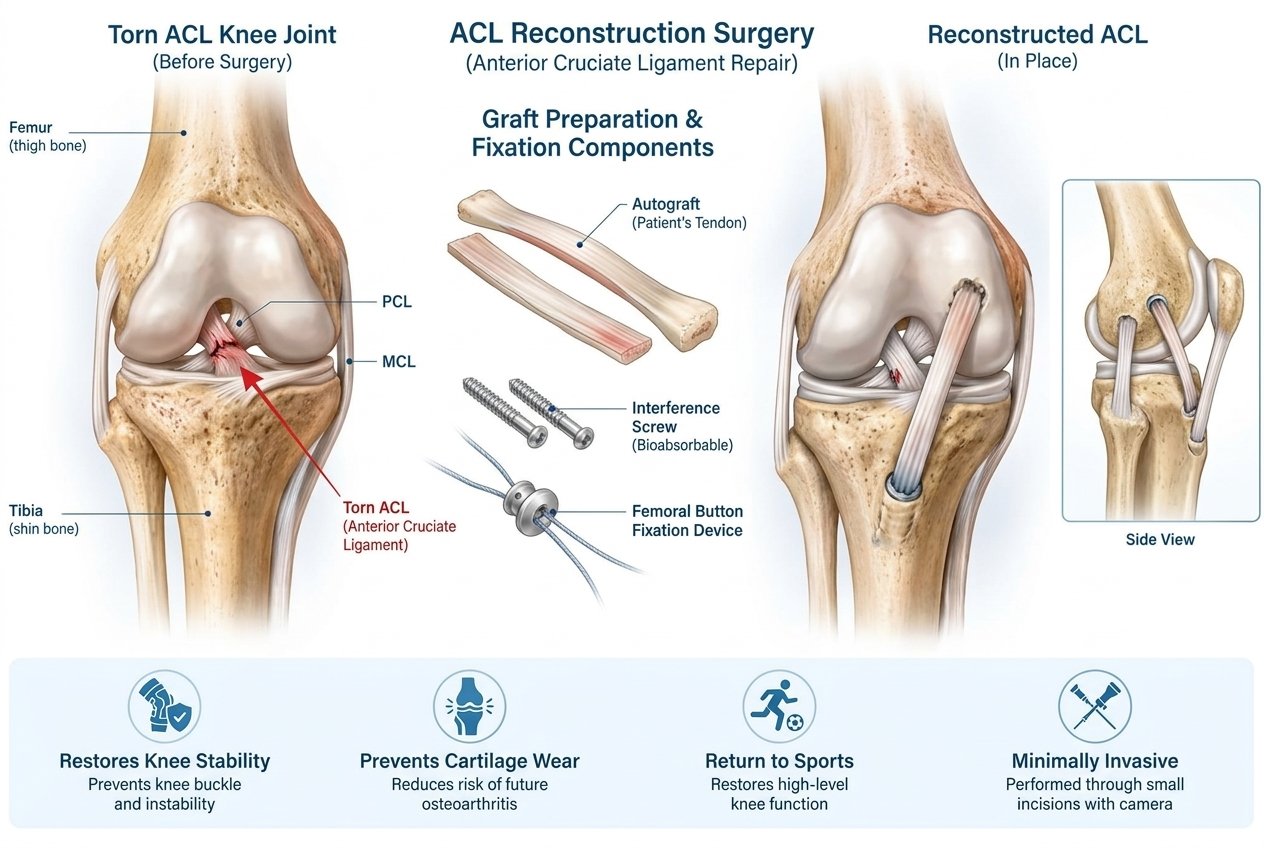 Arthroscopic joint procedures
Clinical Overview & Disease Information
Arthroscopy is a minimally invasive surgical procedure used to diagnose and treat problems inside a joint. Instead of making a large incision to open the joint completely, the surgeon uses an arthroscope—a thin, pencil-sized tube equipped with a high-definition camera and a light source. This transmits a magnified image of the inside of the joint onto a video monitor, allowing the surgeon to see and work with extreme precision.
Signs & Symptoms
- • Early Catching, clicking or locking joint pain during activity
- • Mild stiffness after rest
- • Persistent Catching, clicking or locking joint pain
- • Difficulty with daily mobility
- • Pain disturbing sleep
- • Severe acute pain with inability to walk
- • High fever with joint redness
Causes & Risk Factors
Primary Causes & Etiology
- Meniscus tear & shoulder labral tear
- Post-traumatic joint injury
- Age-related cartilage degeneration
Who is at Higher Risk?
- Patients diagnosed with Meniscus tear & shoulder labral tear
- Adults over 45 years
Diagnostic Evaluation & Testing
| Diagnostic Test | Clinical Purpose / What It Shows |
|---|---|
| 3D Imaging & X-Ray for Arthroscopic joint procedures | Precision anatomical mapping and structural evaluation |
Comprehensive Treatment Options
Minimally Invasive: Keyhole Arthroscopic joint procedures
Advanced keyhole procedure with minimal soft tissue disruption.
Surgical: Reconstruction for Arthroscopic joint procedures
Comprehensive surgical intervention for complex anatomical cases.
Advanced Medical Technologies Available in Partner Hospitals
Possible Complications If Untreated
Recovery Timeline, Diet & Lifestyle Care
Recovery Timeline
| Procedure / Stage | Expected Recovery Duration |
|---|---|
| Inpatient Recovery | 3 to 5 days |
| Physical Therapy & Walking | 3 to 4 weeks |
| Full Active Recovery | 6 to 8 weeks |
Recommended Post-Treatment Diet
- High protein healing diet
- Calcium & Vitamin D3
- 2.5L daily hydration
Essential Lifestyle Changes
- Targeted physical therapy
- Avoid heavy lifting
- Maintain healthy body weight
Prevention & Long-Term Health
Frequently Asked Questions
What is the advantage of arthroscopy over open surgery?
Because arthroscopy uses tiny incisions and does not require cutting through large muscles or severely disrupting the joint capsule, patients generally experience significantly less post-operative pain, reduced blood loss, faster healing times, and a lower risk of infection compared to traditional open surgery.
Are you awake during an arthroscopy?
It depends on the joint and the complexity of the repair. Most shoulder and hip arthroscopies require general anesthesia (you are completely asleep). Knee and ankle arthroscopies are frequently done using regional anesthesia (like a spinal block, where you are numb from the waist down) combined with a mild sedative to keep you relaxed.
What is the recovery time?
Because arthroscopy treats so many different conditions, recovery varies wildly. Simple Debridement: If the surgeon just trims a small meniscus tear or removes a loose body, you might walk out of the hospital on your own and return to basic activities in a few days. Complex Repairs: If the surgeon repairs a rotator cuff or reconstructs an ACL, the healing relies on biology, not just the tiny incisions. Those procedures will still require a sling or brace, weeks of restricted movement, and months of physical therapy to heal fully.
Will I need physical therapy?
Almost always. Even for minor procedures, physical therapy is crucial to restore full range of motion, rebuild muscle strength that was lost due to the initial injury, and prevent the joint from becoming stiff with scar tissue.
Top Recommended Specialists Available

Dr. I P S Oberoi
Chairperson - Orthopaedics Program & Chief – Robotic Joint Replacement & Arthroscopy Surgery
View Doctor Profile →
Dr. (Col) Suvasish Chakraberty
Sr. Consultant - Orthopaedics & Joint Replacement
View Doctor Profile →
Dr. (Prof.) Ravi Sauhta
Chief and HOD - Orthopaedics & Joint Replacement (Unit VI)
View Doctor Profile →
Dr. Sanjay Sarup
Head – Orthopaedics (Unit-II) & Chief – Paediatric Orthopaedics & Spine Surgery
View Doctor Profile →
Global Cost Comparison Matrix
| Procedure | USA (Avg) | India (ISG) | Turkey (Avg) | Thailand (Avg) |
|---|---|---|---|---|
| Arthroscopic joint procedures | $40,000-42,000 | $5,000-6,000 | $8,500-9,500 | $9,500-11,000 |
Request Free Clinical Opinion & Cost Estimate
Upload your diagnostic reports or medical summary for a free review by leading specialists within 24-48 hours.
Get Free Treatment EstimateCommonly Prescribed Medications
- Etoricoxib 90mg daily
- Paracetamol 1g as needed
- Calcium Carbonate + D3
International Patient Guide
- Valid Passport & Visa
- Medical Records & X-Ray CDs