
Motion-Preserving Artificial Disc Replacement
Artificial disc replacement (ADR), also known as total disc replacement, is a surgical procedure in which a degenerated or damaged intervertebral disc is removed and replaced with a synthetic implant. This procedure is an alternative to spinal fusion. While fusion permanently locks two vertebrae together, ADR is designed to preserve the natural motion (flexion, extension, and rotation) of the spinal segment. It is primarily performed in the cervical (neck) and lumbar (lower back) spine.
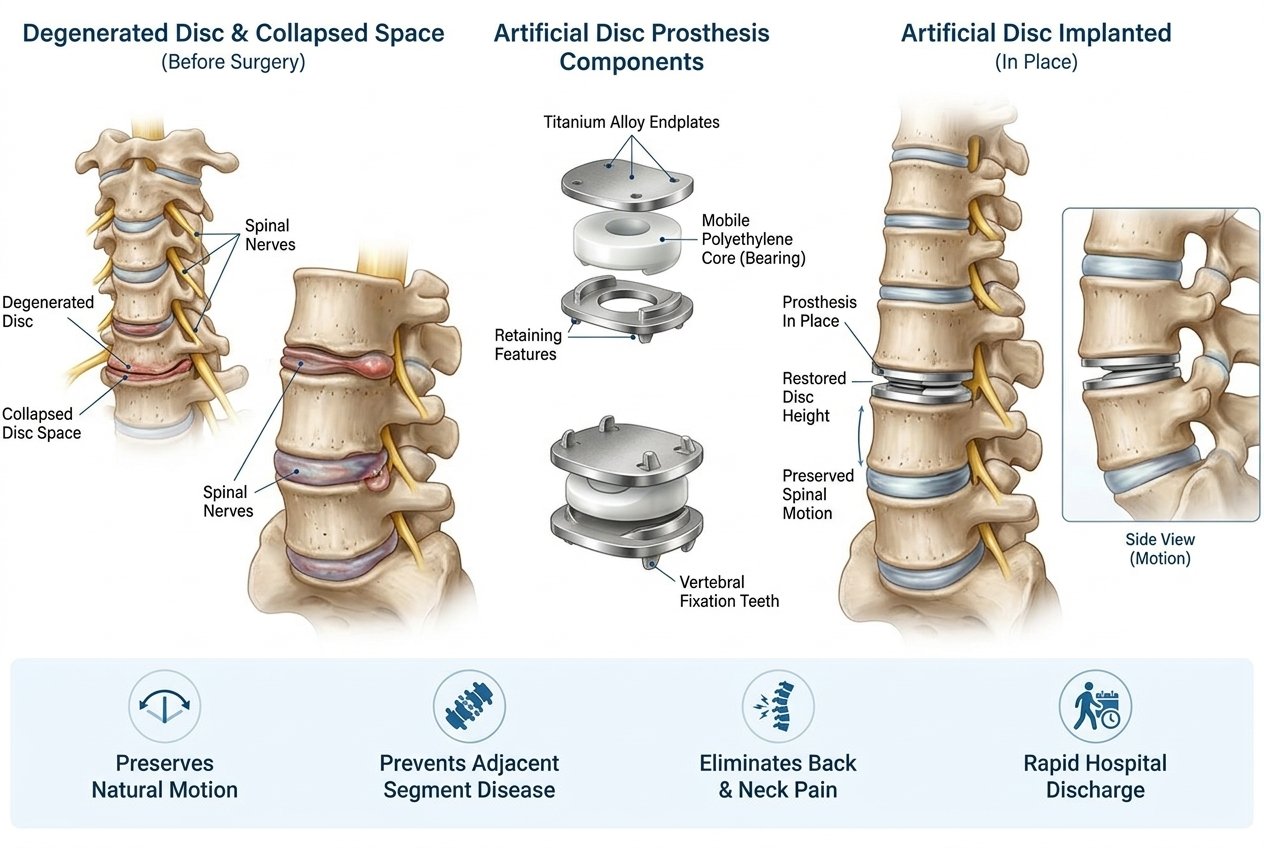 Artificial disc replacement (cervical & lumbar)
Clinical Overview & Disease Information
Artificial disc replacement (ADR), also known as total disc replacement, is a surgical procedure in which a degenerated or damaged intervertebral disc is removed and replaced with a synthetic implant. This procedure is an alternative to spinal fusion. While fusion permanently locks two vertebrae together, ADR is designed to preserve the natural motion (flexion, extension, and rotation) of the spinal segment. It is primarily performed in the cervical (neck) and lumbar (lower back) spine.
Signs & Symptoms
- • Degenerative Disc Disease (DDD)
- • Herniated Discs
- • Radiculopathy or Myelopathy
- • Early Neck pain radiating down arm during activity
- • Mild stiffness after rest
- • Persistent Neck pain radiating down arm
- • Difficulty with daily mobility
- • Pain disturbing sleep
- • Severe acute pain with inability to walk
- • High fever with joint redness
Causes & Risk Factors
Primary Causes & Etiology
- Cervical disc degeneration
- Post-traumatic joint injury
- Age-related cartilage degeneration
Who is at Higher Risk?
- Patients diagnosed with Cervical disc degeneration
- Adults over 45 years
Diagnostic Evaluation & Testing
| Diagnostic Test | Clinical Purpose / What It Shows |
|---|---|
| 3D Imaging & X-Ray for Artificial disc replacement (cervical & lumbar) | Precision anatomical mapping and structural evaluation |
Comprehensive Treatment Options
Minimally Invasive: Keyhole Artificial disc replacement (cervical & lumbar)
Advanced keyhole procedure with minimal soft tissue disruption.
Surgical: Reconstruction for Artificial disc replacement (cervical & lumbar)
Comprehensive surgical intervention for complex anatomical cases.
Advanced Medical Technologies Available in Partner Hospitals
Possible Complications If Untreated
Recovery Timeline, Diet & Lifestyle Care
Recovery Timeline
| Procedure / Stage | Expected Recovery Duration |
|---|---|
| Inpatient Recovery | 3 to 5 days |
| Physical Therapy & Walking | 3 to 4 weeks |
| Full Active Recovery | 6 to 8 weeks |
Recommended Post-Treatment Diet
- High protein healing diet
- Calcium & Vitamin D3
- 2.5L daily hydration
Essential Lifestyle Changes
- Targeted physical therapy
- Avoid heavy lifting
- Maintain healthy body weight
Prevention & Long-Term Health
Frequently Asked Questions
What is the success rate for Artificial disc replacement (cervical & lumbar)?
Clinical success rates exceed 95% with expert surgical technique and physical therapy.
Is artificial disc replacement better than spinal fusion?
For the right candidate, ADR offers distinct advantages over fusion. The most significant benefit is the preservation of motion, which theoretically reduces the stress transferred to the adjacent spinal segments, thereby lowering the risk of "adjacent segment disease" (premature wear and tear on neighboring discs). ADR also typically allows for a faster return to normal activities since there is no need to wait for bones to fuse.
What is the recovery timeline?
Recovery is generally faster than with a spinal fusion. Most cervical ADR patients go home the same day or the next day, and lumbar ADR patients may stay 1 to 2 days. Because the implant is immediately stable, patients are encouraged to walk right away. Soft collars or braces are rarely needed. Most patients can return to light office work within 1 to 3 weeks and resume full, unrestricted activities (including sports) within 6 to 12 weeks.
How long does an artificial disc last?
Current data suggests that artificial discs are highly durable. Long-term studies tracking patients for 10 to 15 years show excellent implant survivorship, with very low rates of mechanical failure or the need for a revision surgery. However, because the technology is relatively newer than fusion, definitive 30-to-40-year data is still being gathered.
Can an artificial disc be placed in any part of the spine?
No. ADR is currently FDA-approved for specific levels in the cervical spine (C3 to C7) and the lumbar spine (L3 to S1). It is not performed in the thoracic (mid-back) spine, as the rib cage naturally limits motion in that area, making disc degeneration much less common and fusion highly effective when surgery is needed.
Top Recommended Specialists Available

Dr. I P S Oberoi
Chairperson - Orthopaedics Program & Chief – Robotic Joint Replacement & Arthroscopy Surgery
View Doctor Profile →
Dr. (Col) Suvasish Chakraberty
Sr. Consultant - Orthopaedics & Joint Replacement
View Doctor Profile →
Dr. (Prof.) Ravi Sauhta
Chief and HOD - Orthopaedics & Joint Replacement (Unit VI)
View Doctor Profile →
Dr. Sanjay Sarup
Head – Orthopaedics (Unit-II) & Chief – Paediatric Orthopaedics & Spine Surgery
View Doctor Profile →
Global Cost Comparison Matrix
| Procedure | USA (Avg) | India (ISG) | Turkey (Avg) | Thailand (Avg) |
|---|---|---|---|---|
| Artificial disc replacement (cervical & lumbar) | $42,000-45,000 | $8,000-10,000 | $10,000-12,000 | $12,000-14,000 |
Request Free Clinical Opinion & Cost Estimate
Upload your diagnostic reports or medical summary for a free review by leading specialists within 24-48 hours.
Get Free Treatment EstimateCommonly Prescribed Medications
- Etoricoxib 90mg daily
- Paracetamol 1g as needed
- Calcium Carbonate + D3
International Patient Guide
- Valid Passport & Visa
- Medical Records & X-Ray CDs