
ExcelsiusGPS Robotic Spine Surgery
ExcelsiusGPS is an advanced robotic navigation platform manufactured by Globus Medical, designed to improve precision, safety, and efficiency in spine surgery. It combines a rigid robotic arm with full navigation capabilities on a single platform, allowing surgeons to precisely place implants (like pedicle screws) during spinal fusion procedures.
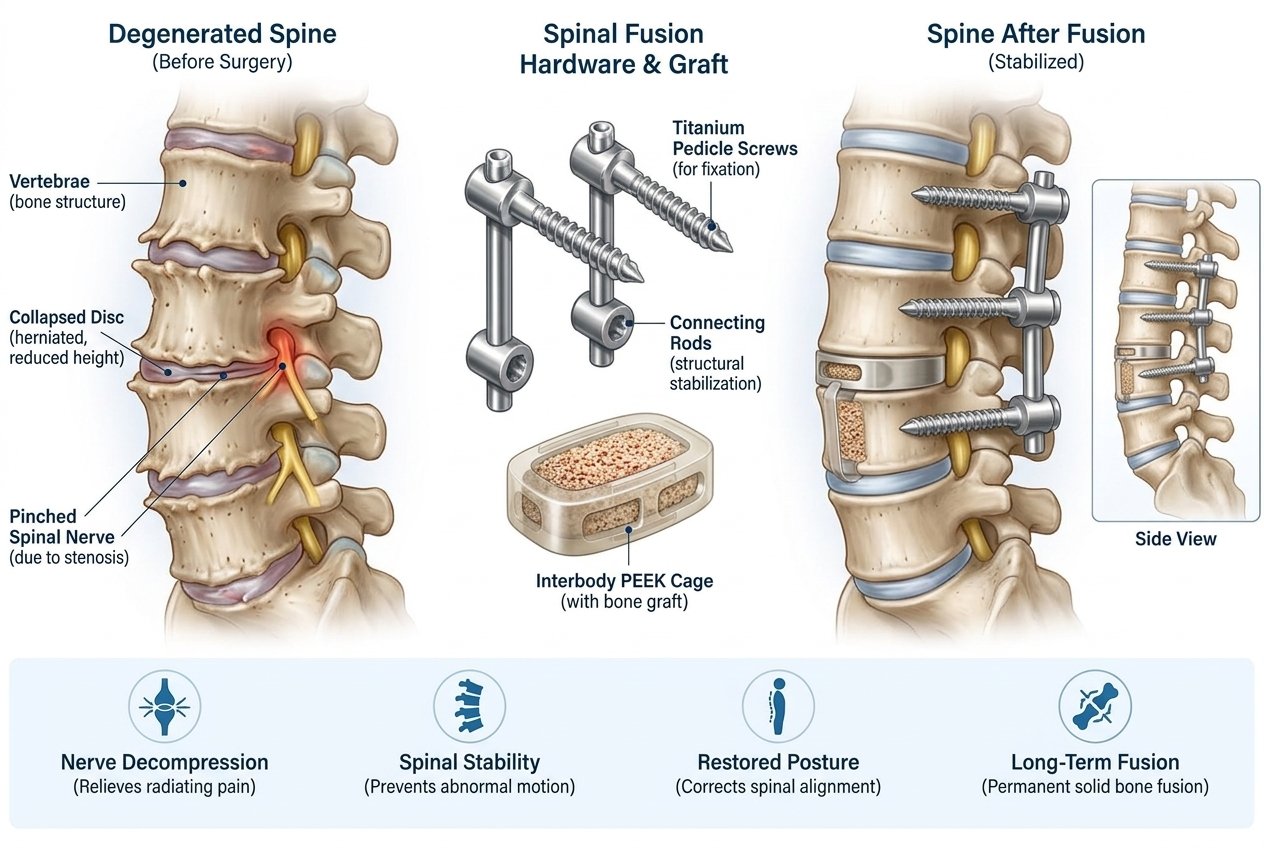 ExcelsiusGPS robotic spine surgery
Clinical Overview & Disease Information
ExcelsiusGPS is an advanced robotic navigation platform manufactured by Globus Medical, designed to improve precision, safety, and efficiency in spine surgery. It combines a rigid robotic arm with full navigation capabilities on a single platform, allowing surgeons to precisely place implants (like pedicle screws) during spinal fusion procedures.
Signs & Symptoms
- • Early Severe spinal instability during activity
- • Mild stiffness after rest
- • Persistent Severe spinal instability
- • Difficulty with daily mobility
- • Pain disturbing sleep
- • Severe acute pain with inability to walk
- • High fever with joint redness
Causes & Risk Factors
Primary Causes & Etiology
- Complex spinal deformity
- Post-traumatic joint injury
- Age-related cartilage degeneration
Who is at Higher Risk?
- Patients diagnosed with Complex spinal deformity
- Adults over 45 years
Diagnostic Evaluation & Testing
| Diagnostic Test | Clinical Purpose / What It Shows |
|---|---|
| 3D Imaging & X-Ray for ExcelsiusGPS robotic spine surgery | Precision anatomical mapping and structural evaluation |
Comprehensive Treatment Options
Minimally Invasive: Keyhole ExcelsiusGPS robotic spine surgery
Advanced keyhole procedure with minimal soft tissue disruption.
Surgical: Reconstruction for ExcelsiusGPS robotic spine surgery
Comprehensive surgical intervention for complex anatomical cases.
Advanced Medical Technologies Available in Partner Hospitals
Possible Complications If Untreated
Recovery Timeline, Diet & Lifestyle Care
Recovery Timeline
| Procedure / Stage | Expected Recovery Duration |
|---|---|
| Inpatient Recovery | 3 to 5 days |
| Physical Therapy & Walking | 3 to 4 weeks |
| Full Active Recovery | 6 to 8 weeks |
Recommended Post-Treatment Diet
- High protein healing diet
- Calcium & Vitamin D3
- 2.5L daily hydration
Essential Lifestyle Changes
- Targeted physical therapy
- Avoid heavy lifting
- Maintain healthy body weight
Prevention & Long-Term Health
Frequently Asked Questions
Does the robot perform the surgery automatically?
No. The robot does not perform the surgery, drill the bone, or make decisions. It functions as an incredibly precise, rigid guide. The orthopedic surgeon or neurosurgeon is entirely in control, performing the actual drilling and screw placement while the robotic arm ensures they stay on the planned path.
What are the main benefits of using ExcelsiusGPS?
The primary benefits include enhanced precision in screw placement (reducing the risk of nerve or blood vessel damage), the ability to perform more minimally invasive surgeries (MISS) through smaller incisions, and a significant reduction in radiation exposure for both the patient and the operating room staff, as fewer continuous X-rays are needed during the procedure.
Is it safer than traditional "freehand" spine surgery?
Studies generally show that robotic navigation systems like ExcelsiusGPS increase the accuracy of pedicle screw placement compared to traditional freehand techniques, particularly in complex deformities or minimally invasive procedures where the surgeon cannot directly see the entire bone. Furthermore, if the patient moves or breathes heavily, the system dynamically tracks and adjusts, or the surgeon can easily abort and recalibrate.
Can the system be used for cervical (neck) fusions?
Currently, most robotic systems, including ExcelsiusGPS, are primarily utilized and FDA-cleared for the thoracic, lumbar, and sacral regions of the spine (the mid to lower back). While technology is advancing rapidly, robotic placement of cervical hardware is less common due to the smaller anatomy and high flexibility of the neck.
Top Recommended Specialists Available

Dr. I P S Oberoi
Chairperson - Orthopaedics Program & Chief – Robotic Joint Replacement & Arthroscopy Surgery
View Doctor Profile →
Dr. (Col) Suvasish Chakraberty
Sr. Consultant - Orthopaedics & Joint Replacement
View Doctor Profile →
Dr. (Prof.) Ravi Sauhta
Chief and HOD - Orthopaedics & Joint Replacement (Unit VI)
View Doctor Profile →
Dr. Sanjay Sarup
Head – Orthopaedics (Unit-II) & Chief – Paediatric Orthopaedics & Spine Surgery
View Doctor Profile →
Global Cost Comparison Matrix
| Procedure | USA (Avg) | India (ISG) | Turkey (Avg) | Thailand (Avg) |
|---|---|---|---|---|
| ExcelsiusGPS robotic spine surgery | $42,000-45,000 | $9,000-10,500 | $12,000-13,000 | $10,500-12,500 |
Request Free Clinical Opinion & Cost Estimate
Upload your diagnostic reports or medical summary for a free review by leading specialists within 24-48 hours.
Get Free Treatment EstimateCommonly Prescribed Medications
- Etoricoxib 90mg daily
- Paracetamol 1g as needed
- Calcium Carbonate + D3
International Patient Guide
- Valid Passport & Visa
- Medical Records & X-Ray CDs