
Limb Lengthening & Deformity Correction
Limb lengthening and deformity correction are complex orthopedic procedures based on a biological process called distraction osteogenesis. This process exploits the body's natural ability to heal bone fractures. By deliberately cutting a bone and then very slowly pulling the two ends apart, the body continuously grows new bone tissue (callus) in the gap. Once the desired length or alignment is achieved, the new bone hardens (consolidates) into solid, normal bone.
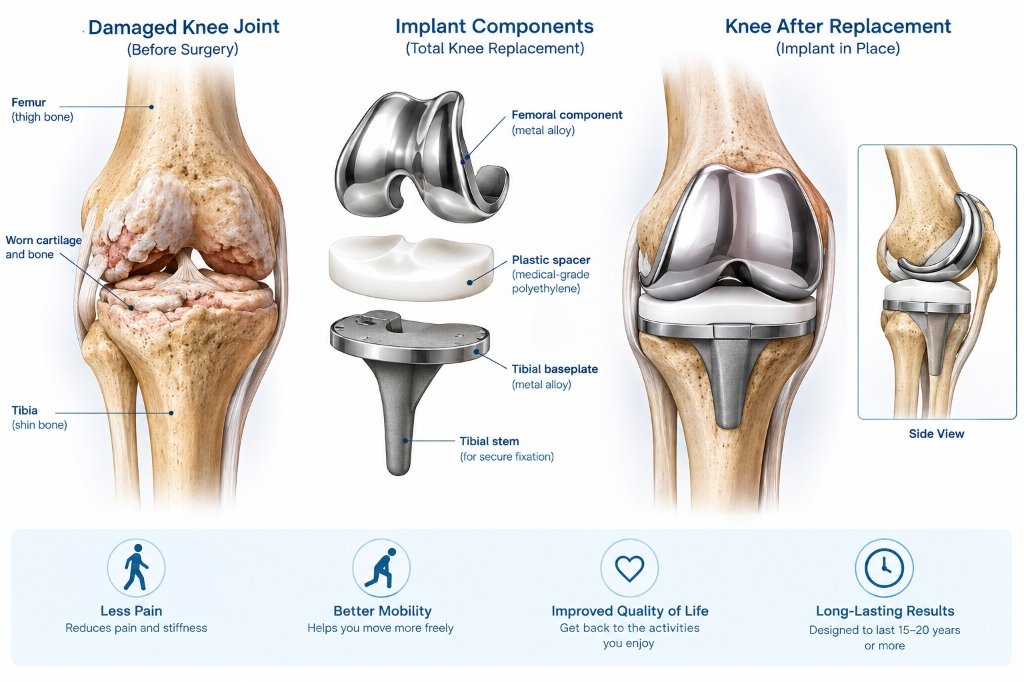 Limb lengthening & deformity correction
Clinical Overview & Disease Information
Limb lengthening and deformity correction are complex orthopedic procedures based on a biological process called distraction osteogenesis. This process exploits the body's natural ability to heal bone fractures. By deliberately cutting a bone and then very slowly pulling the two ends apart, the body continuously grows new bone tissue (callus) in the gap. Once the desired length or alignment is achieved, the new bone hardens (consolidates) into solid, normal bone.
Signs & Symptoms
- • Early Limb length discrepancy > 3cm during activity
- • Mild stiffness after rest
- • Persistent Limb length discrepancy > 3cm
- • Difficulty with daily mobility
- • Pain disturbing sleep
- • Severe acute pain with inability to walk
- • High fever with joint redness
Causes & Risk Factors
Primary Causes & Etiology
- Congenital short limb & post-trauma
- Post-traumatic joint injury
- Age-related cartilage degeneration
Who is at Higher Risk?
- Patients diagnosed with Congenital short limb & post-trauma
- Adults over 45 years
Diagnostic Evaluation & Testing
| Diagnostic Test | Clinical Purpose / What It Shows |
|---|---|
| 3D Imaging & X-Ray for Limb lengthening & deformity correction | Precision anatomical mapping and structural evaluation |
Comprehensive Treatment Options
Minimally Invasive: Keyhole Limb lengthening & deformity correction
Advanced keyhole procedure with minimal soft tissue disruption.
Surgical: Reconstruction for Limb lengthening & deformity correction
Comprehensive surgical intervention for complex anatomical cases.
Advanced Medical Technologies Available in Partner Hospitals
Possible Complications If Untreated
Recovery Timeline, Diet & Lifestyle Care
Recovery Timeline
| Procedure / Stage | Expected Recovery Duration |
|---|---|
| Inpatient Recovery | 3 to 5 days |
| Physical Therapy & Walking | 3 to 4 weeks |
| Full Active Recovery | 6 to 8 weeks |
Recommended Post-Treatment Diet
- High protein healing diet
- Calcium & Vitamin D3
- 2.5L daily hydration
Essential Lifestyle Changes
- Targeted physical therapy
- Avoid heavy lifting
- Maintain healthy body weight
Prevention & Long-Term Health
Frequently Asked Questions
How fast does the bone lengthen?
The standard rate of distraction is approximately 1 millimeter per day (usually divided into 3 or 4 tiny micro-adjustments). Lengthening too fast can stretch the nerves and blood vessels beyond their limits, causing permanent damage. Lengthening too slowly can allow the bone to heal prematurely before the target length is reached.
How much height can be gained?
Safely, a single bone segment (like the femur or the tibia) can be lengthened by up to 2 inches (5 cm) to 3 inches (8 cm). Pushing beyond this significantly increases the risk of severe complications, including muscle contractures, nerve paralysis, and joint stiffness. To gain more height (e.g., up to 6 inches), surgeons must lengthen both the femurs and the tibias in separate, staged surgeries.
How long does the entire process take?
The rule of thumb is that it takes roughly 1 month of recovery for every 1 centimeter of bone lengthened. Therefore, lengthening a bone by 5 centimeters (2 inches) generally requires 5 to 6 months before the new bone is fully hardened and the patient can walk without assistive devices.
Is the procedure painful?
Yes. While the actual distraction of the bone is usually painless (as 1/4 of a millimeter is too small to feel), the continuous stretching of the surrounding muscles, fascia, and nerves causes significant deep aching and tightness. Aggressive, daily physical therapy is mandatory to prevent the muscles from tightening up permanently (contractures) and is often the most grueling part of the recovery process.
Top Recommended Specialists Available

Dr. I P S Oberoi
Chairperson - Orthopaedics Program & Chief – Robotic Joint Replacement & Arthroscopy Surgery
View Doctor Profile →
Dr. (Col) Suvasish Chakraberty
Sr. Consultant - Orthopaedics & Joint Replacement
View Doctor Profile →
Dr. (Prof.) Ravi Sauhta
Chief and HOD - Orthopaedics & Joint Replacement (Unit VI)
View Doctor Profile →
Dr. Sanjay Sarup
Head – Orthopaedics (Unit-II) & Chief – Paediatric Orthopaedics & Spine Surgery
View Doctor Profile →
Global Cost Comparison Matrix
| Procedure | USA (Avg) | India (ISG) | Turkey (Avg) | Thailand (Avg) |
|---|---|---|---|---|
| Limb lengthening & deformity correction | $50,000-$1,00,000 | $9,500-$14,000 | $12,000-$18,000 | $13,000-$18,000 |
Request Free Clinical Opinion & Cost Estimate
Upload your diagnostic reports or medical summary for a free review by leading specialists within 24-48 hours.
Get Free Treatment EstimateCommonly Prescribed Medications
- Etoricoxib 90mg daily
- Paracetamol 1g as needed
- Calcium Carbonate + D3
International Patient Guide
- Valid Passport & Visa
- Medical Records & X-Ray CDs