
Minimally Invasive Spine Surgery (MISS)
Minimally Invasive Spine Surgery (MISS) is a specialized surgical approach used to treat spinal disorders with less trauma to the surrounding muscles and tissues compared to traditional "open" spine surgery. Instead of making a long incision and pulling the back muscles away from the spine, MISS uses small incisions, specialized retractors, and advanced imaging technology to access the spine.
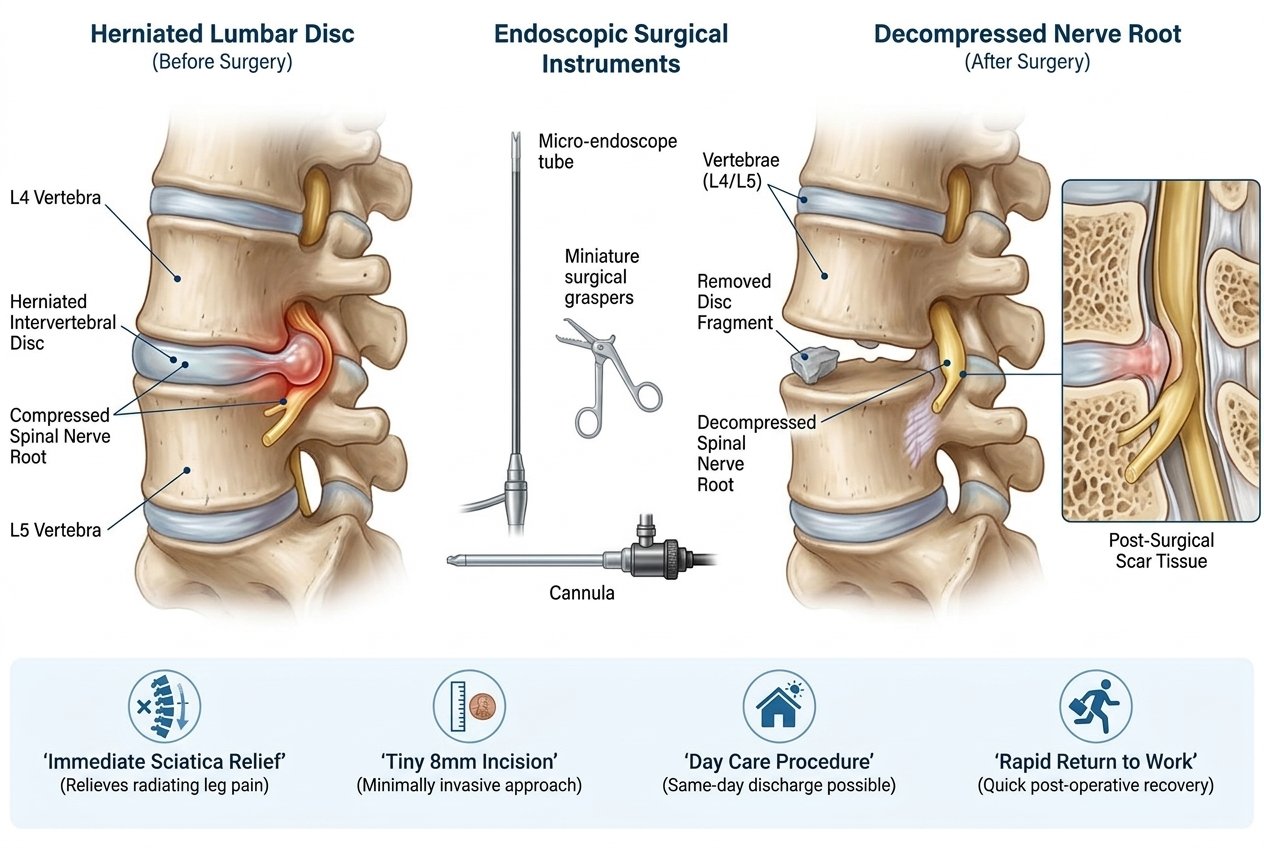 Minimally invasive spine surgery (MISS)
Clinical Overview & Disease Information
Minimally Invasive Spine Surgery (MISS) is a specialized surgical approach used to treat spinal disorders with less trauma to the surrounding muscles and tissues compared to traditional "open" spine surgery. Instead of making a long incision and pulling the back muscles away from the spine, MISS uses small incisions, specialized retractors, and advanced imaging technology to access the spine.
Signs & Symptoms
- • Early Sciatica leg pain & numbness during activity
- • Mild stiffness after rest
- • Persistent Sciatica leg pain & numbness
- • Difficulty with daily mobility
- • Pain disturbing sleep
- • Severe acute pain with inability to walk
- • High fever with joint redness
Causes & Risk Factors
Primary Causes & Etiology
- Spinal stenosis
- Spinal Tumors or Infections
- Herniated Discs
- Spondylolisthesis & Instability
Who is at Higher Risk?
- Patients diagnosed with Herniated lumbar disc & spinal stenosis
- Adults over 45 years
Diagnostic Evaluation & Testing
| Diagnostic Test | Clinical Purpose / What It Shows |
|---|---|
| 3D Imaging & X-Ray for Minimally invasive spine surgery (MISS) | Precision anatomical mapping and structural evaluation |
Comprehensive Treatment Options
Minimally Invasive: Keyhole Minimally invasive spine surgery (MISS)
Advanced keyhole procedure with minimal soft tissue disruption.
Surgical: Reconstruction for Minimally invasive spine surgery (MISS)
Comprehensive surgical intervention for complex anatomical cases.
Advanced Medical Technologies Available in Partner Hospitals
Possible Complications If Untreated
Recovery Timeline, Diet & Lifestyle Care
Recovery Timeline
| Procedure / Stage | Expected Recovery Duration |
|---|---|
| Inpatient Recovery | 3 to 5 days |
| Physical Therapy & Walking | 3 to 4 weeks |
| Full Active Recovery | 6 to 8 weeks |
Recommended Post-Treatment Diet
- High protein healing diet
- Calcium & Vitamin D3
- 2.5L daily hydration
Essential Lifestyle Changes
- Targeted physical therapy
- Avoid heavy lifting
- Maintain healthy body weight
Prevention & Long-Term Health
Frequently Asked Questions
Is MISS appropriate for everyone?
No. While highly effective, MISS is not suited for all spinal conditions. Complex spinal deformities (like severe scoliosis), large tumors, multi-level fusions, or cases requiring a very wide view of the spinal anatomy are often better suited for traditional open surgery to ensure safety and surgical success. Your surgeon's experience and your specific anatomy dictate the best approach.
Are the long-term results better with MISS?
Studies generally show that while the short-term recovery (first few weeks to months) is significantly faster and less painful with MISS, the long-term outcomes (at 1 to 2 years out) regarding pain relief and functional improvement are generally equal between MISS and traditional open surgery for the same condition.
Does MISS use lasers?
Generally, no. While "laser spine surgery" is often heavily marketed as minimally invasive, major medical organizations and academic spine surgeons rarely use lasers. Traditional MISS uses precise surgical instruments (scalpels, burrs, and biters) through small tubes, which is proven to be safe and highly effective. Lasers do not provide a clear advantage and carry a risk of thermal (heat) damage to the delicate spinal nerves.
Top Recommended Specialists Available

Dr. I P S Oberoi
Chairperson - Orthopaedics Program & Chief – Robotic Joint Replacement & Arthroscopy Surgery
View Doctor Profile →
Dr. (Col) Suvasish Chakraberty
Sr. Consultant - Orthopaedics & Joint Replacement
View Doctor Profile →
Dr. (Prof.) Ravi Sauhta
Chief and HOD - Orthopaedics & Joint Replacement (Unit VI)
View Doctor Profile →
Dr. Sanjay Sarup
Head – Orthopaedics (Unit-II) & Chief – Paediatric Orthopaedics & Spine Surgery
View Doctor Profile →
Global Cost Comparison Matrix
| Procedure | USA (Avg) | India (ISG) | Turkey (Avg) | Thailand (Avg) |
|---|---|---|---|---|
| Minimally invasive spine surgery (MISS) | $40,000-42,000 | $6,000-7,000 | $8,500-9,500 | $10,000-11,000 |
Request Free Clinical Opinion & Cost Estimate
Upload your diagnostic reports or medical summary for a free review by leading specialists within 24-48 hours.
Get Free Treatment EstimateCommonly Prescribed Medications
- Etoricoxib 90mg daily
- Paracetamol 1g as needed
- Calcium Carbonate + D3
International Patient Guide
- Valid Passport & Visa
- Medical Records & X-Ray CDs