
Robotic-Assisted Joint Replacement (MAKO / NAVIO)
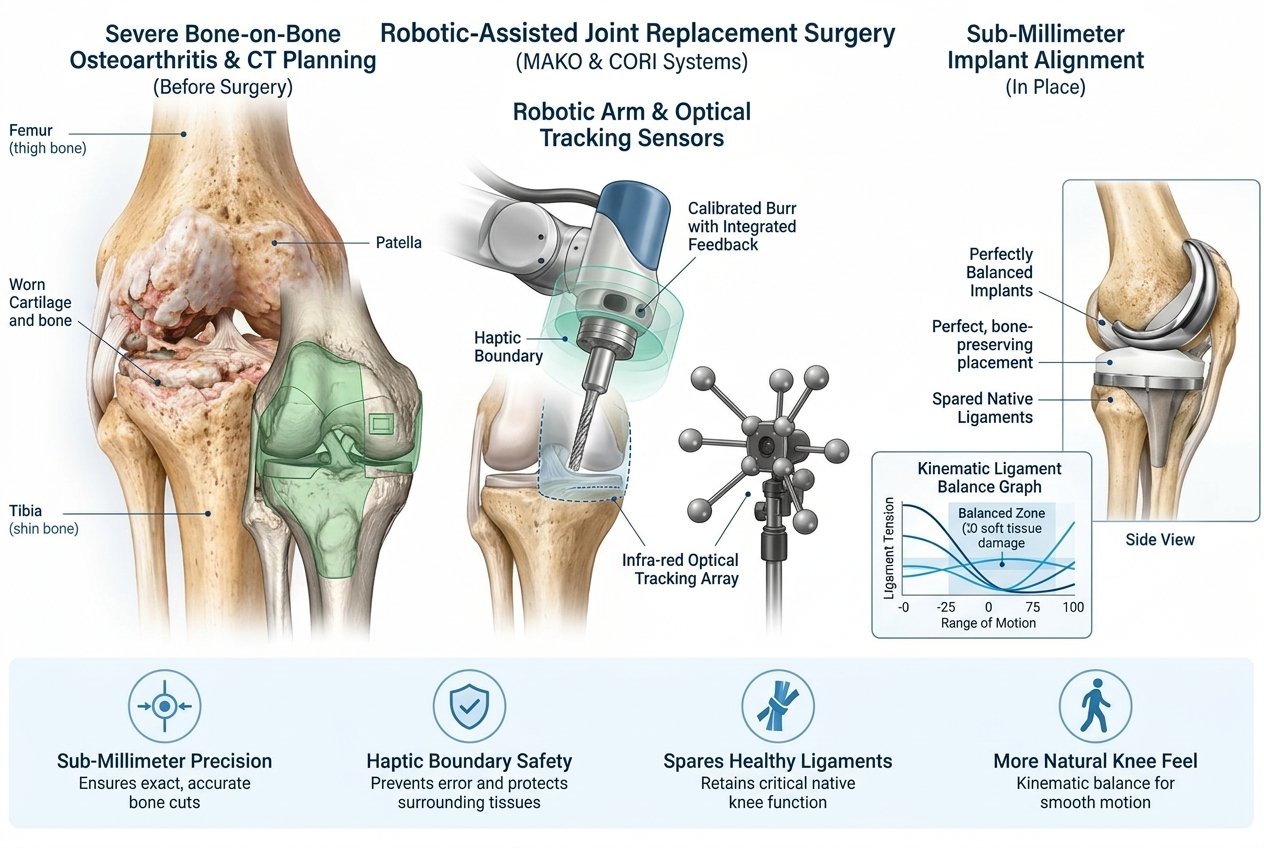
Robotic-assisted joint replacement is an advanced surgical technique where an orthopedic surgeon uses a robotic arm or a handheld robotic device to assist in performing total or partial joint replacements, primarily of the knee and hip. These systems enhance precision and allow for highly personalized surgical planning.
 Robotic joint replacement (MAKO, CORI, Navio)
Clinical Overview & Disease Information
Robotic-assisted joint replacement is an advanced surgical technique where an orthopedic surgeon uses a robotic arm or a handheld robotic device to assist in performing total or partial joint replacements, primarily of the knee and hip. These systems enhance precision and allow for highly personalized surgical planning.
Signs & Symptoms
- • Moderate knee or hip pain during walking
- • Morning joint stiffness lasting 30 mins
- • Severe joint pain unresponsive to medication
- • Joint instability and bow-leg deformity
- • Inability to walk short distances without pain
- • Sudden joint locking
- • Acute hot swollen joint
Causes & Risk Factors
Primary Causes & Etiology
- Severe Tricompartmental Osteoarthritis
- Complex joint deformities (>15 degree varus/valgus)
- Post-traumatic cartilage destruction
Who is at Higher Risk?
- Active seniors seeking natural knee feel
- Patients with complex bony deformities
Diagnostic Evaluation & Testing
| Diagnostic Test | Clinical Purpose / What It Shows |
|---|---|
| 3D CT Scanogram & Alignment Scan | Generates virtual 3D anatomical model for robotic surgical planning |
| Dynamic Intraoperative Ligament Tension Mapping | Measures real-time ligament balance through full range of motion |
Comprehensive Treatment Options
Robotic-Assisted MAKO / NAVIO Partial & Total Joint Replacement
Robotic arm enforces haptic boundaries to protect soft tissue.
Robotic Revision Joint Reconstruction
Robotic navigation for precise implant revision and bone defect augmentation.
Advanced Medical Technologies Available in Partner Hospitals
Possible Complications If Untreated
Recovery Timeline, Diet & Lifestyle Care
Recovery Timeline
| Procedure / Stage | Expected Recovery Duration |
|---|---|
| Day 1 Post-Op | Full weight-bearing walking without brace |
| Hospital Discharge | 2 to 3 days post surgery |
| Walking without Walker | 2 weeks |
| Return to Sports & Driving | 4 weeks |
Recommended Post-Treatment Diet
- Collagen peptide supplements
- High protein diet
- Anti-inflammatory berries
Essential Lifestyle Changes
- Home robotic rehab app exercises
- Stationary cycling
- Low-impact fitness
Prevention & Long-Term Health
Frequently Asked Questions
Does the robot perform the surgery automatically?
No, the robot does not operate independently. Your orthopedic surgeon is in complete control at all times. The robotic system acts as a highly advanced tool that guides the surgeon's hands and prevents them from cutting outside the pre-planned boundaries.
What are the benefits of robotic over traditional joint replacement?
The primary advantage is exceptional precision in bone preparation and implant positioning. Proper alignment can lead to a more natural-feeling joint, better preservation of healthy soft tissue, potentially faster initial recovery, and a lower risk of the implant failing or wearing out prematurely.
Do all these systems require a CT scan before surgery?
No. The MAKO system requires a pre-operative CT scan to create the 3D surgical plan. The NAVIO and CORI systems are "imageless," meaning they do not require a CT or MRI beforehand. Instead, the surgeon maps your joint's anatomy directly in the operating room.
Is the recovery time faster with a robotic procedure?
Many studies report that patients undergoing robotic-assisted surgery may experience less post-operative pain, require fewer pain medications, and achieve earlier mobilization in the first few weeks compared to traditional methods due to reduced soft tissue trauma. However, the overall timeline to reach maximum medical improvement and full strength remains similar (typically 3 to 6 months).
Top Recommended Specialists Available

Dr. I P S Oberoi
Chairperson - Orthopaedics Program & Chief – Robotic Joint Replacement & Arthroscopy Surgery
View Doctor Profile →
Dr. (Col) Suvasish Chakraberty
Sr. Consultant - Orthopaedics & Joint Replacement
View Doctor Profile →
Dr. (Prof.) Ravi Sauhta
Chief and HOD - Orthopaedics & Joint Replacement (Unit VI)
View Doctor Profile →
Dr. Sanjay Sarup
Head – Orthopaedics (Unit-II) & Chief – Paediatric Orthopaedics & Spine Surgery
View Doctor Profile →
Global Cost Comparison Matrix
| Procedure | USA (Avg) | India (ISG) | Turkey (Avg) | Thailand (Avg) |
|---|---|---|---|---|
| Robotic joint replacement (MAKO, CORI, Navio) | $40,000-45,000 | $8,000-9,000 | $10,500-12,000 | $12,000-14,000 |
Request Free Clinical Opinion & Cost Estimate
Upload your diagnostic reports or medical summary for a free review by leading specialists within 24-48 hours.
Get Free Treatment EstimateCommonly Prescribed Medications
- Celecoxib 200mg daily
- Paracetamol 1g
- Rivaroxaban 10mg (DVT prevention)
International Patient Guide
- Passport & Visa
- CT Scanogram CD
- Medical Summary