
Lumbar & Cervical Spinal Fusion
Spinal fusion is a surgical procedure designed to permanently connect two or more vertebrae in the spine, eliminating motion between them. The procedure mimics the normal healing process of broken bones by using bone grafts and metal hardware to create a solid, single structure. It can be performed in the cervical (neck), thoracic (mid-back), or lumbar (lower back) regions of the spine.
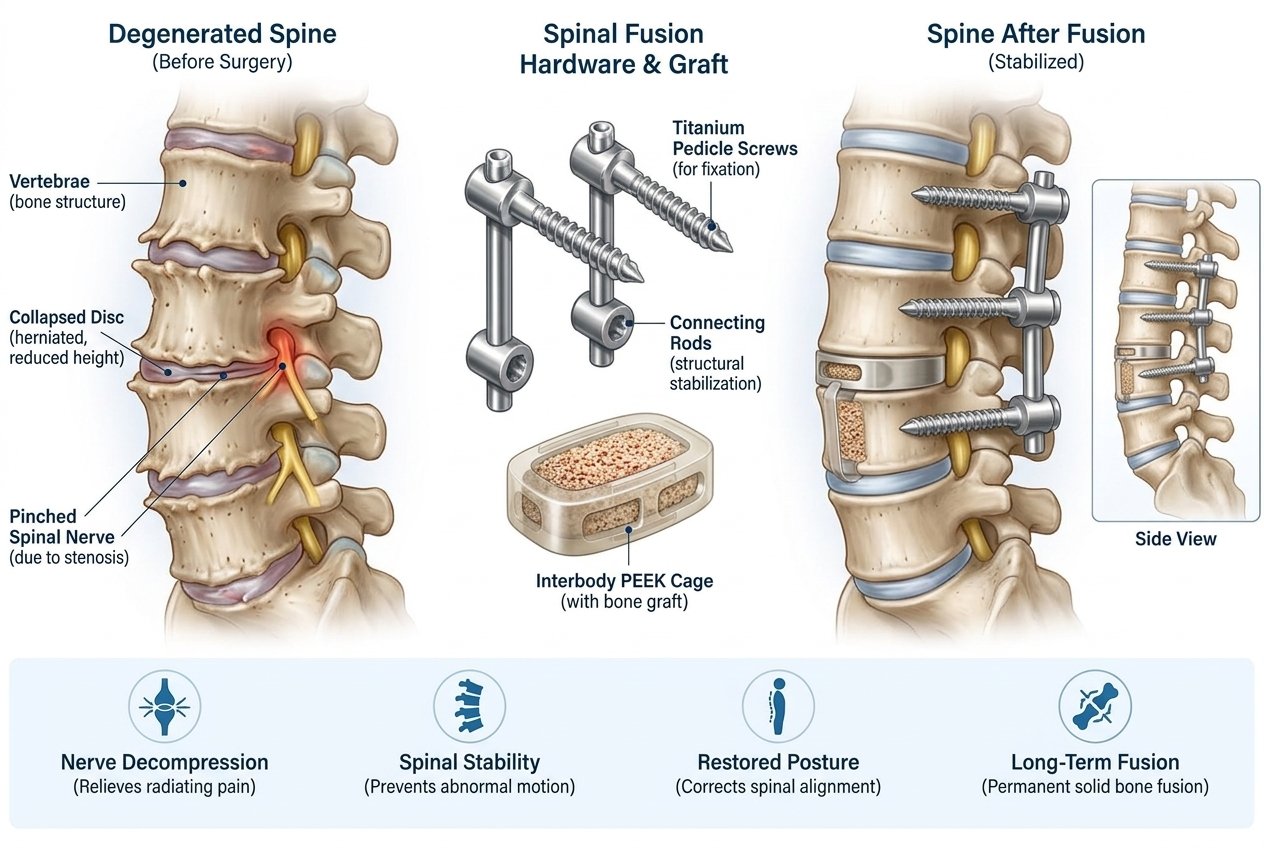 Spinal fusion surgery
Clinical Overview & Disease Information
Spinal fusion is a surgical procedure designed to permanently connect two or more vertebrae in the spine, eliminating motion between them. The procedure mimics the normal healing process of broken bones by using bone grafts and metal hardware to create a solid, single structure. It can be performed in the cervical (neck), thoracic (mid-back), or lumbar (lower back) regions of the spine.
Signs & Symptoms
- • Early Severe lower back pain radiating to legs during activity
- • Mild stiffness after rest
- • Persistent Severe lower back pain radiating to legs
- • Difficulty with daily mobility
- • Pain disturbing sleep
- • Severe acute pain with inability to walk
- • High fever with joint redness
Causes & Risk Factors
Primary Causes & Etiology
- Spondylolisthesis & Slipped Disc
- Spinal Deformities
- Degenerative Disk Disease
- Fractures or Tumors
- Spinal Stenosis
Who is at Higher Risk?
- Patients diagnosed with Spondylolisthesis & Slipped Disc
- Adults over 45 years
Diagnostic Evaluation & Testing
| Diagnostic Test | Clinical Purpose / What It Shows |
|---|---|
| 3D Imaging & X-Ray for Spinal fusion surgery | Precision anatomical mapping and structural evaluation |
Comprehensive Treatment Options
Minimally Invasive: Keyhole Spinal fusion surgery
Advanced keyhole procedure with minimal soft tissue disruption.
Surgical: Reconstruction for Spinal fusion surgery
Comprehensive surgical intervention for complex anatomical cases.
Advanced Medical Technologies Available in Partner Hospitals
Possible Complications If Untreated
Recovery Timeline, Diet & Lifestyle Care
Recovery Timeline
| Procedure / Stage | Expected Recovery Duration |
|---|---|
| Inpatient Recovery | 3 to 5 days |
| Physical Therapy & Walking | 3 to 4 weeks |
| Full Active Recovery | 6 to 8 weeks |
Recommended Post-Treatment Diet
- High protein healing diet
- Calcium & Vitamin D3
- 2.5L daily hydration
Essential Lifestyle Changes
- Targeted physical therapy
- Avoid heavy lifting
- Maintain healthy body weight
Prevention & Long-Term Health
Frequently Asked Questions
What is the success rate for Spinal fusion surgery?
Clinical success rates exceed 95% with expert surgical technique and physical therapy.
Will a spinal fusion limit my flexibility?
Yes, because the fused vertebrae will no longer move independently. However, the degree of limitation depends heavily on the number of levels fused and the region of the spine. A single-level lumbar fusion often results in very little noticeable loss of mobility, as the surrounding joints compensate. Fusing multiple segments will result in a more noticeable decrease in range of motion.
What is the recovery timeline?
While you may leave the hospital in 1 to 4 days, the actual biological fusion of the bones takes 3 to 6 months to become solid, and up to a year to fully mature. During the first 4 to 6 weeks, you will have strict restrictions against bending, lifting (anything over 10 lbs), and twisting (the "BLT" restrictions). Most patients can return to desk jobs in 4 to 6 weeks, but heavy physical labor may require 3 to 6 months of recovery.
What happens if the bones don't fuse?
This is a complication known as "pseudarthrosis" or nonunion. If the bone graft fails to bridge the gap and fuse the vertebrae, the metal hardware may eventually loosen or break due to continuous stress, often requiring a second revision surgery. Smoking, obesity, diabetes, and certain medications (like NSAIDs) significantly increase the risk of nonunion.
What is "adjacent segment disease"?
Because the fused segment of the spine no longer moves, the spinal discs and joints immediately above and below the fusion have to absorb extra stress and movement. Over time, this increased mechanical load can accelerate wear and tear on those adjacent segments, potentially leading to pain or the need for further surgery years down the line.
Top Recommended Specialists Available

Dr. I P S Oberoi
Chairperson - Orthopaedics Program & Chief – Robotic Joint Replacement & Arthroscopy Surgery
View Doctor Profile →
Dr. (Col) Suvasish Chakraberty
Sr. Consultant - Orthopaedics & Joint Replacement
View Doctor Profile →
Dr. (Prof.) Ravi Sauhta
Chief and HOD - Orthopaedics & Joint Replacement (Unit VI)
View Doctor Profile →
Dr. Sanjay Sarup
Head – Orthopaedics (Unit-II) & Chief – Paediatric Orthopaedics & Spine Surgery
View Doctor Profile →
Global Cost Comparison Matrix
| Procedure | USA (Avg) | India (ISG) | Turkey (Avg) | Thailand (Avg) |
|---|---|---|---|---|
| Spinal fusion surgery | $42,000-45,000 | $8,000-10,000 | $9,500-11,000 | $12,000-14,000 |
Request Free Clinical Opinion & Cost Estimate
Upload your diagnostic reports or medical summary for a free review by leading specialists within 24-48 hours.
Get Free Treatment EstimateCommonly Prescribed Medications
- Etoricoxib 90mg daily
- Paracetamol 1g as needed
- Calcium Carbonate + D3
International Patient Guide
- Valid Passport & Visa
- Medical Records & X-Ray CDs