
Arthroscopic ACL & Ligament Reconstruction
Anterior Cruciate Ligament (ACL) reconstruction is a surgical procedure to replace a torn ACL, one of the major stabilizing ligaments in the knee. The ACL crosses diagonally in the middle of the knee, providing rotational stability and preventing the tibia (shinbone) from sliding out in front of the femur (thighbone). Because the ACL cannot heal on its own when completely torn, surgical reconstruction is often required to restore knee stability, particularly for active individuals.
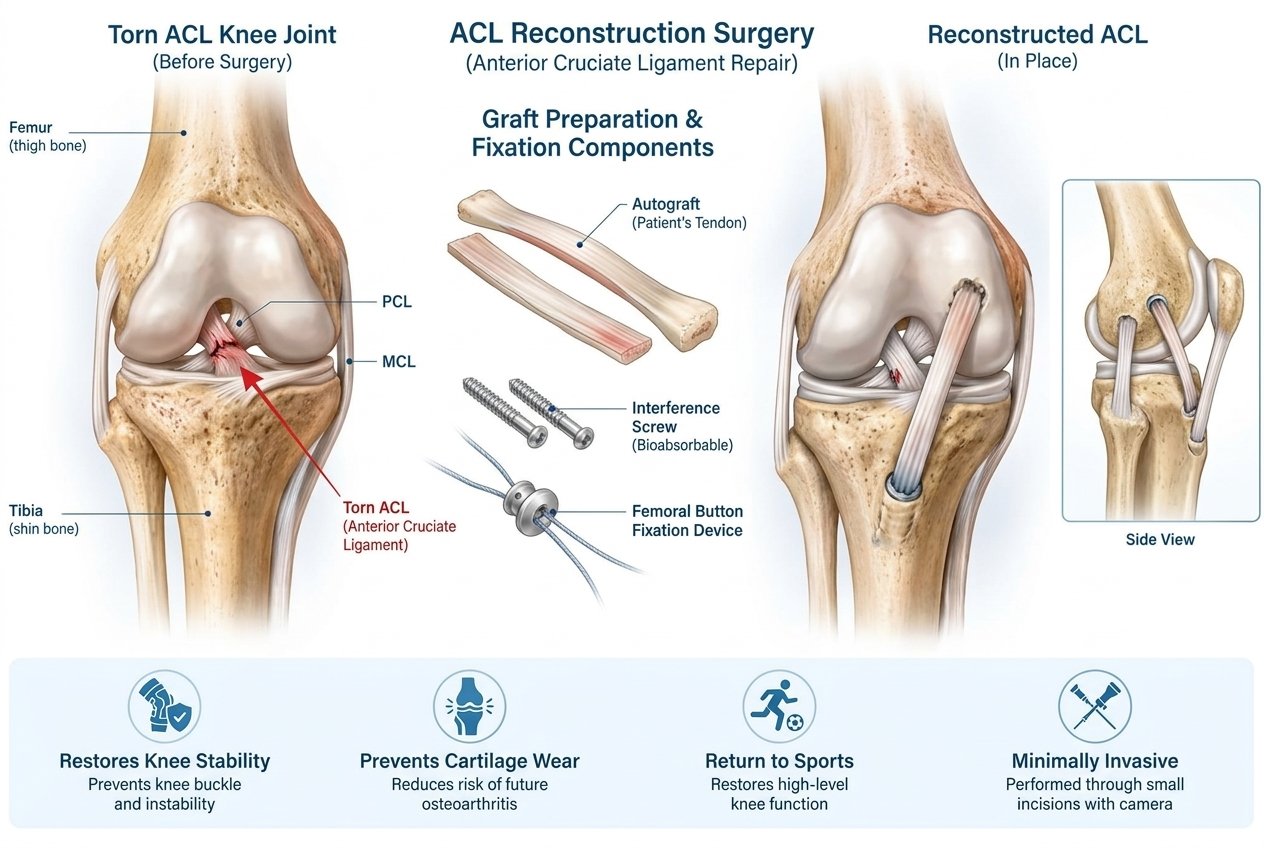 Sports injury & ACL / ligament reconstruction
Clinical Overview & Disease Information
Anterior Cruciate Ligament (ACL) reconstruction is a surgical procedure to replace a torn ACL, one of the major stabilizing ligaments in the knee. The ACL crosses diagonally in the middle of the knee, providing rotational stability and preventing the tibia (shinbone) from sliding out in front of the femur (thighbone). Because the ACL cannot heal on its own when completely torn, surgical reconstruction is often required to restore knee stability, particularly for active individuals.
Signs & Symptoms
- • Early Knee giving way during pivot movement during activity
- • Mild stiffness after rest
- • Persistent Knee giving way during pivot movement
- • Difficulty with daily mobility
- • Pain disturbing sleep
- • Severe acute pain with inability to walk
- • High fever with joint redness
Causes & Risk Factors
Primary Causes & Etiology
- Sports ACL tear & meniscus injury
- Post-traumatic joint injury
- Age-related cartilage degeneration
Who is at Higher Risk?
- Patients diagnosed with Sports ACL tear & meniscus injury
- Adults over 45 years
Diagnostic Evaluation & Testing
| Diagnostic Test | Clinical Purpose / What It Shows |
|---|---|
| 3D Imaging & X-Ray for Sports injury & ACL / ligament reconstruction | Precision anatomical mapping and structural evaluation |
Comprehensive Treatment Options
Minimally Invasive: Keyhole Sports injury & ACL / ligament reconstruction
Advanced keyhole procedure with minimal soft tissue disruption.
Surgical: Reconstruction for Sports injury & ACL / ligament reconstruction
Comprehensive surgical intervention for complex anatomical cases.
Advanced Medical Technologies Available in Partner Hospitals
Possible Complications If Untreated
Recovery Timeline, Diet & Lifestyle Care
Recovery Timeline
| Procedure / Stage | Expected Recovery Duration |
|---|---|
| Inpatient Recovery | 3 to 5 days |
| Physical Therapy & Walking | 3 to 4 weeks |
| Full Active Recovery | 6 to 8 weeks |
Recommended Post-Treatment Diet
- High protein healing diet
- Calcium & Vitamin D3
- 2.5L daily hydration
Essential Lifestyle Changes
- Targeted physical therapy
- Avoid heavy lifting
- Maintain healthy body weight
Prevention & Long-Term Health
Frequently Asked Questions
Why can't the ACL just be sewn back together?
Unlike many other ligaments (like the MCL), the ACL is located entirely inside the joint fluid (synovial fluid) of the knee. This fluid prevents the formation of a blood clot, which is the necessary first step in natural tissue healing. Therefore, suturing the two torn ends together usually fails, and a complete reconstruction with a new graft is required.
Which is better: using my own tendon (autograft) or a donor tendon (allograft)?
Both are highly successful, but the choice depends on age and activity level. Autografts (your own tissue) have lower re-tear rates in young, highly active athletes (under 25) because the tissue integrates faster and stronger. Allografts (donor tissue) require a smaller incision, result in less immediate post-operative pain, and are often preferred for older patients or those undergoing revision (a second) ACL surgery.
How long does it take to return to sports?
Recovery is a long, highly structured process. While patients are walking normally within a few weeks, the new graft undergoes a biological process called "ligamentization," where it is initially very weak before gaining strength. It typically takes 9 to 12 months of intense physical therapy before an athlete is cleared to return to high-demand, pivoting sports safely.
Will I need a brace after surgery?
Protocols vary by surgeon. Some require a straight-leg hinged brace and crutches for the first 2 to 4 weeks, especially if a meniscus repair was done simultaneously. However, modern accelerated rehab protocols often focus on immediate weight-bearing and restoring range of motion as quickly as possible, minimizing the prolonged use of heavy bracing.
Top Recommended Specialists Available

Dr. I P S Oberoi
Chairperson - Orthopaedics Program & Chief – Robotic Joint Replacement & Arthroscopy Surgery
View Doctor Profile →
Dr. (Col) Suvasish Chakraberty
Sr. Consultant - Orthopaedics & Joint Replacement
View Doctor Profile →
Dr. (Prof.) Ravi Sauhta
Chief and HOD - Orthopaedics & Joint Replacement (Unit VI)
View Doctor Profile →
Dr. Sanjay Sarup
Head – Orthopaedics (Unit-II) & Chief – Paediatric Orthopaedics & Spine Surgery
View Doctor Profile →
Global Cost Comparison Matrix
| Procedure | USA (Avg) | India (ISG) | Turkey (Avg) | Thailand (Avg) |
|---|---|---|---|---|
| Sports injury & ACL / ligament reconstruction | $35,000-38,000 | $5,000-6,000 | $8,500-9,500 | $9,500-10,500 |
Request Free Clinical Opinion & Cost Estimate
Upload your diagnostic reports or medical summary for a free review by leading specialists within 24-48 hours.
Get Free Treatment EstimateCommonly Prescribed Medications
- Etoricoxib 90mg daily
- Paracetamol 1g as needed
- Calcium Carbonate + D3
International Patient Guide
- Valid Passport & Visa
- Medical Records & X-Ray CDs