
Total Hip Replacement (Hip Arthroplasty)
Total hip replacement (arthroplasty) is a surgical procedure where a diseased or damaged hip joint is removed and replaced with an artificial joint (prosthesis). The hip is a "ball-and-socket" joint; this surgery replaces both the ball (the femoral head) and the socket (the acetabulum) with metal, ceramic, or hard plastic components.
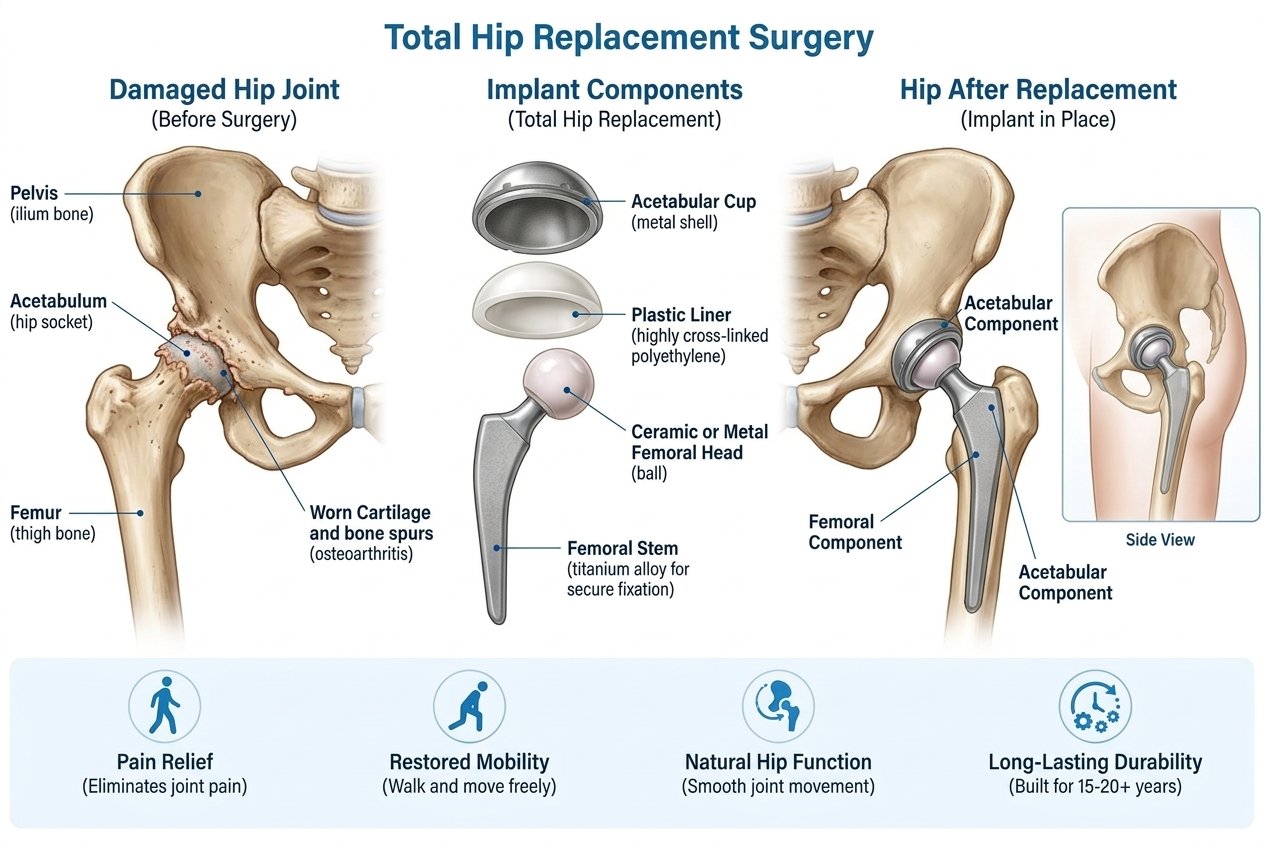 Total hip replacement
Clinical Overview & Disease Information
Total hip replacement (arthroplasty) is a surgical procedure where a diseased or damaged hip joint is removed and replaced with an artificial joint (prosthesis). The hip is a "ball-and-socket" joint; this surgery replaces both the ball (the femoral head) and the socket (the acetabulum) with metal, ceramic, or hard plastic components.
Signs & Symptoms
- • Groin or buttock pain during walking
- • Difficulty putting on socks or tying shoes
- • Hip stiffness after sitting
- • Deep groin pain radiating to thigh and knee
- • Noticeable limp or leg length discrepancy
- • Pain when resting or sleeping on the side
- • Inability to rotate the hip joint
- • Sudden severe hip pain with leg shortened and turned outward (dislocation)
- • Inability to stand or bear weight
- • High fever with hip joint redness
Causes & Risk Factors
Primary Causes & Etiology
- Avascular Necrosis (AVN) of femoral head
- Hip Osteoarthritis & Hip Dysplasia (DDH)
- Ankylosing Spondylitis & Rheumatoid Arthritis
- Femoral neck fracture in elderly
Who is at Higher Risk?
- Patients with history of heavy steroid use or alcohol (AVN)
- Adults over 50 with hip osteoarthritis
- Individuals with childhood hip dysplasia
Diagnostic Evaluation & Testing
| Diagnostic Test | Clinical Purpose / What It Shows |
|---|---|
| Pelvis AP & Hip Lateral X-Rays | Evaluates acetabular cup depth, femoral head sphericity, and joint space |
| MRI Pelvis with Hip Joints | Early detection of Avascular Necrosis (AVN) bone marrow edema |
| CT Scan Pelvis 3D Reconstruction | Pre-op 3D planning for custom cup and stem positioning |
Comprehensive Treatment Options
Minimally Invasive: Direct Anterior Approach (DAA) Hip Replacement
Surgical incision between muscle planes without cutting hip muscles.
Surgical: Complex Hip Revision & AVN Reconstruction
Reconstruction using ceramic-on-ceramic bearings and porous titanium cups.
Advanced Medical Technologies Available in Partner Hospitals
Possible Complications If Untreated
Recovery Timeline, Diet & Lifestyle Care
Recovery Timeline
| Procedure / Stage | Expected Recovery Duration |
|---|---|
| Day 1 Post-Op | Standing and walking with crutches |
| Hospital Discharge | 3 days post surgery |
| Walking without Crutches | 2 to 3 weeks |
| Full Active Recovery | 6 weeks |
Recommended Post-Treatment Diet
- High protein diet
- Calcium 1200mg/day
- Vitamin C for collagen synthesis
Essential Lifestyle Changes
- Avoid crossing legs past midline for 6 weeks
- Use hip abduction pillow while sleeping
- Avoid bending hip past 90 degrees
Prevention & Long-Term Health
Frequently Asked Questions
How long does a hip replacement last?
Thanks to advancements in materials—particularly highly cross-linked polyethylene and ceramics—modern hip implants are extremely durable. For the vast majority of patients (over 85%), a hip replacement will last 15 to 20 years, and often much longer.
What is the recovery time?
Most patients stand and walk with assistance on the same day as their surgery or the day after. Depending on the surgical approach, hospital stays range from outpatient (going home the same day) to a few days. Basic daily activities usually resume within 3 to 6 weeks, with full recovery taking up to 6 to 12 months.
What are "hip precautions"?
Depending on how the surgeon accesses the hip (the surgical approach, such as posterior or anterior), you may be given specific rules to prevent the new hip from popping out of the socket (dislocating) while the tissues heal. These may include not bending your hip past 90 degrees, not crossing your legs, and not turning your feet excessively inward or outward.
When can I drive?
You can typically resume driving 4 to 6 weeks after surgery. However, you must be completely off all narcotic pain medications and have regained enough strength and reflex speed to brake safely.
Will I have any permanent activity restrictions?
While a hip replacement drastically improves mobility and quality of life, most surgeons recommend avoiding high-impact activities like running, jumping, or heavy contact sports to prevent the implant from wearing out prematurely or loosening. Low-impact activities like swimming, cycling, golfing, and hiking are generally highly encouraged.
Top Recommended Specialists Available

Dr. I P S Oberoi
Chairperson - Orthopaedics Program & Chief – Robotic Joint Replacement & Arthroscopy Surgery
View Doctor Profile →
Dr. (Col) Suvasish Chakraberty
Sr. Consultant - Orthopaedics & Joint Replacement
View Doctor Profile →
Dr. (Prof.) Ravi Sauhta
Chief and HOD - Orthopaedics & Joint Replacement (Unit VI)
View Doctor Profile →
Dr. Sanjay Sarup
Head – Orthopaedics (Unit-II) & Chief – Paediatric Orthopaedics & Spine Surgery
View Doctor Profile →
Global Cost Comparison Matrix
| Procedure | USA (Avg) | India (ISG) | Turkey (Avg) | Thailand (Avg) |
|---|---|---|---|---|
| Total hip replacement | $48,000-50,000 | $8,000-10,000 | $10,000-12,000 | $15,000-18,000 |
Request Free Clinical Opinion & Cost Estimate
Upload your diagnostic reports or medical summary for a free review by leading specialists within 24-48 hours.
Get Free Treatment EstimateCommonly Prescribed Medications
- Celecoxib 200mg daily
- Paracetamol 1g as needed
- Rivaroxaban 10mg once daily (DVT prevention)
- Calcium Carbonate + D3
International Patient Guide
- Passport & Medical Visa
- Pelvic X-Ray & MRI CD
- Doctor referral letter