
Total Knee Replacement (Knee Arthroplasty)
Total knee replacement (arthroplasty) is a surgical procedure to resurface a knee damaged by arthritis or injury. The procedure involves removing the damaged cartilage and bone from the surface of the knee joint and replacing them with an artificial implant (prosthesis) made of metal alloys, high-grade plastics, and polymers.
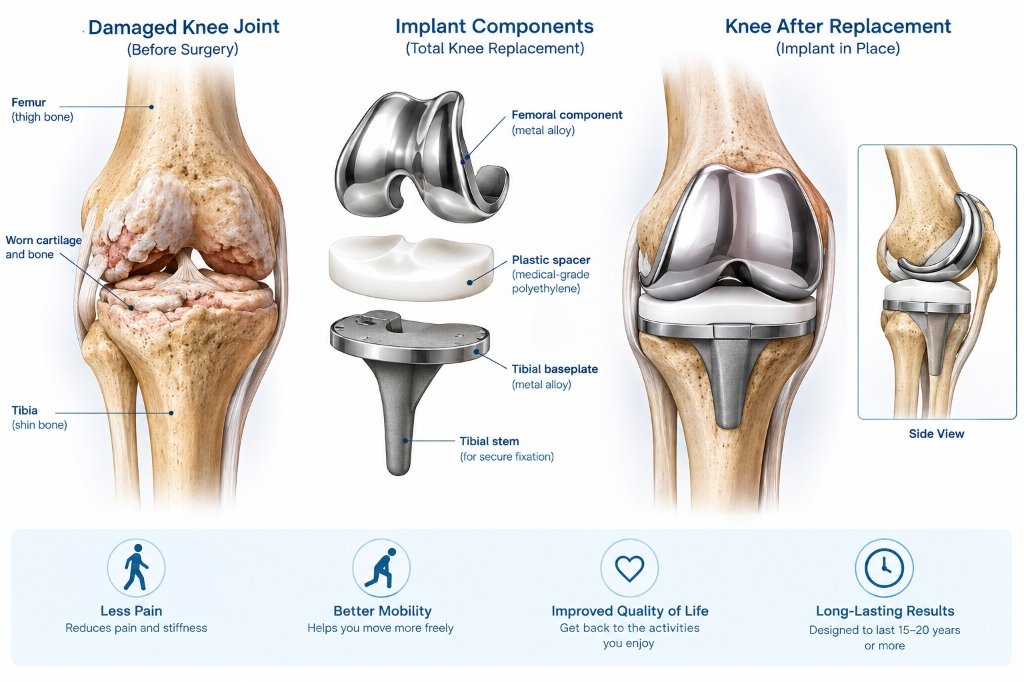 Total knee replacement
Clinical Overview & Disease Information
Total knee replacement (arthroplasty) is a surgical procedure to resurface a knee damaged by arthritis or injury. The procedure involves removing the damaged cartilage and bone from the surface of the knee joint and replacing them with an artificial implant (prosthesis) made of metal alloys, high-grade plastics, and polymers.
Signs & Symptoms
- • Knee stiffness after waking up or sitting
- • Pain climbing stairs or standing up
- • Joint swelling after light walking
- • Persistent severe knee pain preventing walking
- • Bow-legged (Varus) or Knock-knee (Valgus) deformity
- • Bone-on-bone grinding noise (crepitus)
- • Sleep loss due to throbbing knee pain
- • Inability to bear weight on the leg
- • Sudden knee joint locking with acute pain
- • High fever with red, hot, swollen knee
Causes & Risk Factors
Primary Causes & Etiology
- Primary Knee Osteoarthritis (cartilage wear)
- Rheumatoid Arthritis & Inflammatory Gout
- Post-traumatic knee joint injury
- Excess body weight & heavy manual labor
Who is at Higher Risk?
- Adults over 55 years of age
- Obese patients with BMI > 30
- Individuals with previous ACL or meniscus tears
- Manual laborers carrying heavy loads
Diagnostic Evaluation & Testing
| Diagnostic Test | Clinical Purpose / What It Shows |
|---|---|
| Standing Weight-Bearing Knee X-Ray (AP & Lateral) | Measures joint space narrowing, osteophytes, and mechanical axis alignment |
| MRI Knee Joint 3.0T | Evaluates articular cartilage thickness, meniscus status, and collateral ligaments |
| Serum ESR & CRP Inflammatory Markers | Rule out septic arthritis and active rheumatoid joint inflammation |
Comprehensive Treatment Options
Minimally Invasive: Computer-Navigated TKR
Precision computer guidance places implants with sub-millimeter alignment.
Surgical: Complex & Revision Knee Arthroplasty
Reconstruction for severe bone loss or previously failed knee implants.
Advanced Medical Technologies Available in Partner Hospitals
Possible Complications If Untreated
Recovery Timeline, Diet & Lifestyle Care
Recovery Timeline
| Procedure / Stage | Expected Recovery Duration |
|---|---|
| Day 1 Post-Op | Walking with walker assistance |
| Hospital Discharge | 3 to 4 days post surgery |
| Unassisted Walking | 3 to 4 weeks |
| Full Driving & Active Life | 6 to 8 weeks |
Recommended Post-Treatment Diet
- High protein muscle healing diet (1.2g/kg)
- Calcium Carbonate 1200mg/day + Vitamin D3
- 2.5 Liters daily water intake
Essential Lifestyle Changes
- Daily targeted quadriceps exercise
- Use raised toilet seat & commode
- Avoid sitting on hard floor or kneeling
Prevention & Long-Term Health
Frequently Asked Questions
How long does a total knee implant last?
Modern knee implants are highly durable. For roughly 85% to 90% of patients, a total knee replacement functions well for 15 to 20 years, and often much longer, depending on the patient's activity level and weight.
When can I walk after knee replacement?
Most patients begin walking with a walker within 24 hours of surgery.
What is the typical recovery time?
Patients are usually encouraged to stand and walk (with a walker or crutches) the same day or the day after surgery. Basic daily activities are generally resumed within 3 to 6 weeks. It can take 3 to 6 months to achieve a full recovery and return to optimal strength and endurance.
Is the surgery painful?
You will be under anesthesia during the procedure (either general or spinal). Post-operative pain is expected but is aggressively managed with a combination of oral medications, nerve blocks, and sometimes localized pain pumps. Pain significantly decreases over the first few weeks as the knee heals.
What activities will I need to avoid?
While you can return to many activities like walking, swimming, golfing, and cycling, high-impact activities that put excessive stress on the new joint—such as jogging, jumping, or contact sports—are strongly discouraged to prevent premature wear or loosening of the implant.
When can I drive again?
Most patients can resume driving 4 to 6 weeks after surgery, provided they are no longer taking narcotic pain medications and have regained sufficient muscle control and reflex time to safely operate the pedals (especially if the right knee was replaced).
Top Recommended Specialists Available

Dr. I P S Oberoi
Chairperson - Orthopaedics Program & Chief – Robotic Joint Replacement & Arthroscopy Surgery
View Doctor Profile →
Dr. (Col) Suvasish Chakraberty
Sr. Consultant - Orthopaedics & Joint Replacement
View Doctor Profile →
Dr. (Prof.) Ravi Sauhta
Chief and HOD - Orthopaedics & Joint Replacement (Unit VI)
View Doctor Profile →
Dr. Sanjay Sarup
Head – Orthopaedics (Unit-II) & Chief – Paediatric Orthopaedics & Spine Surgery
View Doctor Profile →
Global Cost Comparison Matrix
| Procedure | USA (Avg) | India (ISG) | Turkey (Avg) | Thailand (Avg) |
|---|---|---|---|---|
| Total knee replacement | $45,000-50,000 | $7,000-8,500 | $10,500-12,500 | $12,000-14,000 |
Request Free Clinical Opinion & Cost Estimate
Upload your diagnostic reports or medical summary for a free review by leading specialists within 24-48 hours.
Get Free Treatment EstimateCommonly Prescribed Medications
- Etoricoxib 90mg once daily
- Paracetamol 1g as needed
- Enoxaparin 40mg SC injection (DVT prophylaxis)
- Calcium Carbonate 500mg + D3
International Patient Guide
- Valid Passport & Indian Medical Visa
- Knee X-Rays & MRI CDs
- Previous prescriptions & doctor referral