
Partial Knee Replacement (UKA)
Unicompartmental (partial) knee replacement is a surgical procedure that replaces only the damaged section of the knee joint, preserving the healthy bone, cartilage, and ligaments.The human knee is divided into three compartments: the medial (inside), the lateral (outside), and the patellofemoral (the front of the knee between the kneecap and thighbone). In a partial replacement, the surgeon removes arthritic tissue from just one of these compartments—most commonly the medial side—and caps it with a metal and plastic prosthetic implant.
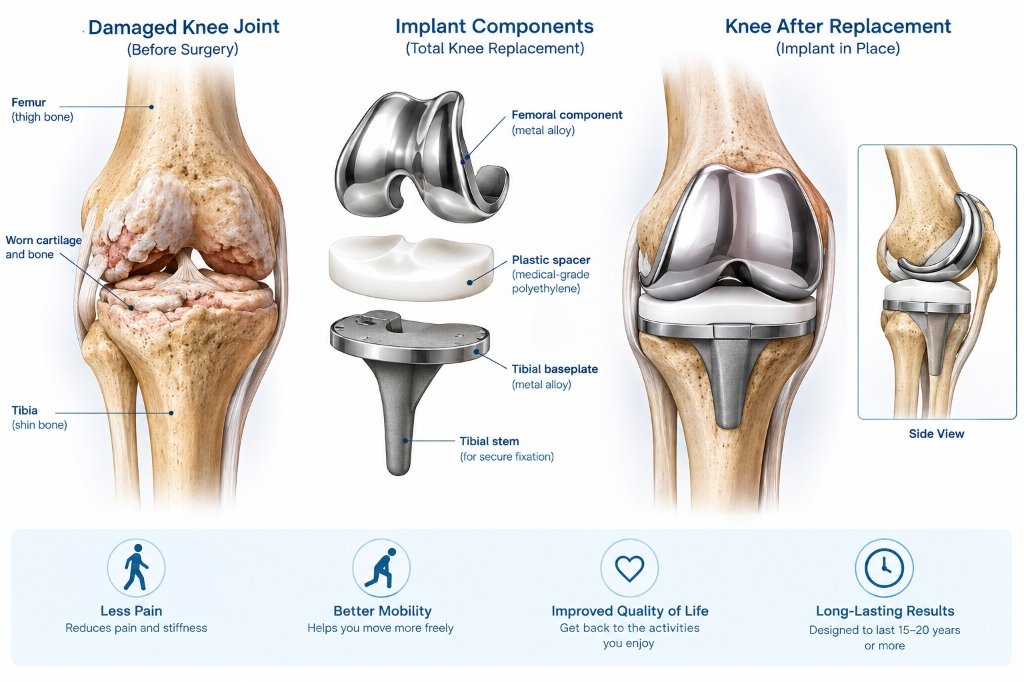 Unicompartmental (partial) knee replacement
Clinical Overview & Disease Information
Unicompartmental (partial) knee replacement is a surgical procedure that replaces only the damaged section of the knee joint, preserving the healthy bone, cartilage, and ligaments.The human knee is divided into three compartments: the medial (inside), the lateral (outside), and the patellofemoral (the front of the knee between the kneecap and thighbone). In a partial replacement, the surgeon removes arthritic tissue from just one of these compartments—most commonly the medial side—and caps it with a metal and plastic prosthetic implant.
Signs & Symptoms
- • Early Medial knee pain when walking during activity
- • Mild stiffness after rest
- • Persistent Medial knee pain when walking
- • Difficulty with daily mobility
- • Pain disturbing sleep
- • Severe acute pain with inability to walk
- • High fever with joint redness
Causes & Risk Factors
Primary Causes & Etiology
- Medial osteoarthritis
- Post-traumatic joint injury
- Age-related cartilage degeneration
Who is at Higher Risk?
- Patients diagnosed with Medial osteoarthritis
- Adults over 45 years
Diagnostic Evaluation & Testing
| Diagnostic Test | Clinical Purpose / What It Shows |
|---|---|
| 3D Imaging & X-Ray for Unicompartmental (partial) knee replacement | Precision anatomical mapping and structural evaluation |
Comprehensive Treatment Options
Minimally Invasive: Keyhole Unicompartmental (partial) knee replacement
Advanced keyhole procedure with minimal soft tissue disruption.
Surgical: Reconstruction for Unicompartmental (partial) knee replacement
Comprehensive surgical intervention for complex anatomical cases.
Advanced Medical Technologies Available in Partner Hospitals
Possible Complications If Untreated
Recovery Timeline, Diet & Lifestyle Care
Recovery Timeline
| Procedure / Stage | Expected Recovery Duration |
|---|---|
| Inpatient Recovery | 3 to 5 days |
| Physical Therapy & Walking | 3 to 4 weeks |
| Full Active Recovery | 6 to 8 weeks |
Recommended Post-Treatment Diet
- High protein healing diet
- Calcium & Vitamin D3
- 2.5L daily hydration
Essential Lifestyle Changes
- Targeted physical therapy
- Avoid heavy lifting
- Maintain healthy body weight
Prevention & Long-Term Health
Frequently Asked Questions
What is the success rate for Unicompartmental (partial) knee replacement?
Clinical success rates exceed 95% with expert surgical technique and physical therapy.
Does a partial knee replacement feel different than a total knee replacement?
Yes. Because the healthy parts of the knee—especially the major ligaments like the ACL and PCL—are preserved, patients often report that a partial knee replacement bends more naturally and feels more like their "own" knee compared to a total knee replacement.
What is the recovery time?
Because the surgical trauma is significantly less, recovery is generally much faster than a total joint replacement. It is frequently performed as an outpatient procedure. Patients typically walk with assistance the same day and can often resume basic daily activities and driving within 3 to 4 weeks.
Will I eventually need a total knee replacement?
It is a possibility. A partial knee replacement only fixes the currently damaged compartment. If osteoarthritis progresses over time and begins to destroy the other, previously healthy compartments of your knee, you may eventually require a revision surgery to convert the partial implant into a total knee replacement.
Are there activity restrictions after a partial knee replacement?
Similar to total joint replacements, you can return to low-impact sports such as swimming, cycling, doubles tennis, and golf once fully healed. However, high-impact activities like running or heavy jumping are typically discouraged to prevent premature wear on the implant or damage to the remaining natural compartments.
Top Recommended Specialists Available

Dr. I P S Oberoi
Chairperson - Orthopaedics Program & Chief – Robotic Joint Replacement & Arthroscopy Surgery
View Doctor Profile →
Dr. (Col) Suvasish Chakraberty
Sr. Consultant - Orthopaedics & Joint Replacement
View Doctor Profile →
Dr. (Prof.) Ravi Sauhta
Chief and HOD - Orthopaedics & Joint Replacement (Unit VI)
View Doctor Profile →
Dr. Sanjay Sarup
Head – Orthopaedics (Unit-II) & Chief – Paediatric Orthopaedics & Spine Surgery
View Doctor Profile →
Global Cost Comparison Matrix
| Procedure | USA (Avg) | India (ISG) | Turkey (Avg) | Thailand (Avg) |
|---|---|---|---|---|
| Unicompartmental (partial) knee replacement | $42,000-45,000 | $5,500-7,000 | $8,500-10,000 | $9,500-11,000 |
Request Free Clinical Opinion & Cost Estimate
Upload your diagnostic reports or medical summary for a free review by leading specialists within 24-48 hours.
Get Free Treatment EstimateCommonly Prescribed Medications
- Etoricoxib 90mg daily
- Paracetamol 1g as needed
- Calcium Carbonate + D3
International Patient Guide
- Valid Passport & Visa
- Medical Records & X-Ray CDs